Skip to content

Premium vehicle detailing, paint correction and ceramic coating

Primary service · R280 per panel

Your array is losing power to a film you cannot see.

Soiling is the quietest fault on a solar installation. Nothing alarms, nothing trips — output simply drifts down as dust, pollen and mineral scale build a haze across the glass. A ceramic coating changes the surface itself so that contamination struggles to hold on, and rain removes most of what does.

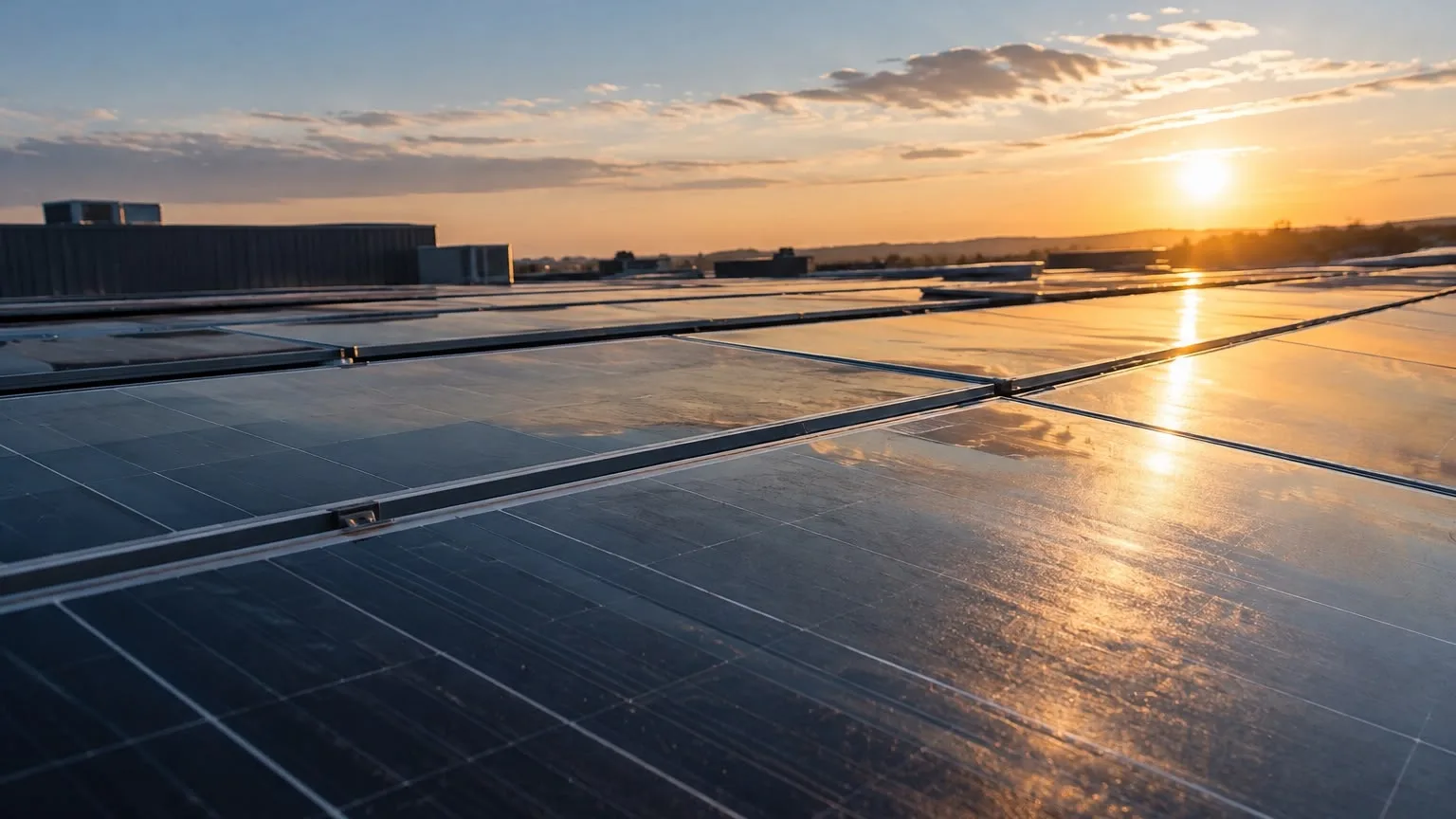
A rooftop photovoltaic array at sunrise, the wet coated modules returning the low sun as one clean sheet of light
R280
Per panel

Inclusive of preparation, coating and cure

10min
Per panel

Typical on-site time once the array is prepped

5yrs
Service life

With the recommended rinse schedule

Solar coating calculator

Drag the panel count. The figures update live at R280 per panel and roughly ten minutes of coating work per panel, worked by a two-person crew.

4300+
Total investment
R6 720

Rate per panel

R280

Estimated time on site

2 h

Suggested booking

One morning

Panels

24

Slots are indicative. We confirm a date once we have seen roof access and the weather window.

This estimate covers preparation, coating and cure for standard rooftop modules at accessible height. Difficult access, heavy mineral scale requiring pre-treatment, or ground-mount arrays are quoted separately after a site visit.

The difference

One module, two surfaces, two yields.

A photovoltaic cell can only convert the light that reaches it. Everything between the sun and the cell — dust, mineral haze, a rough surface scattering light back out — is generation you paid for and did not get.

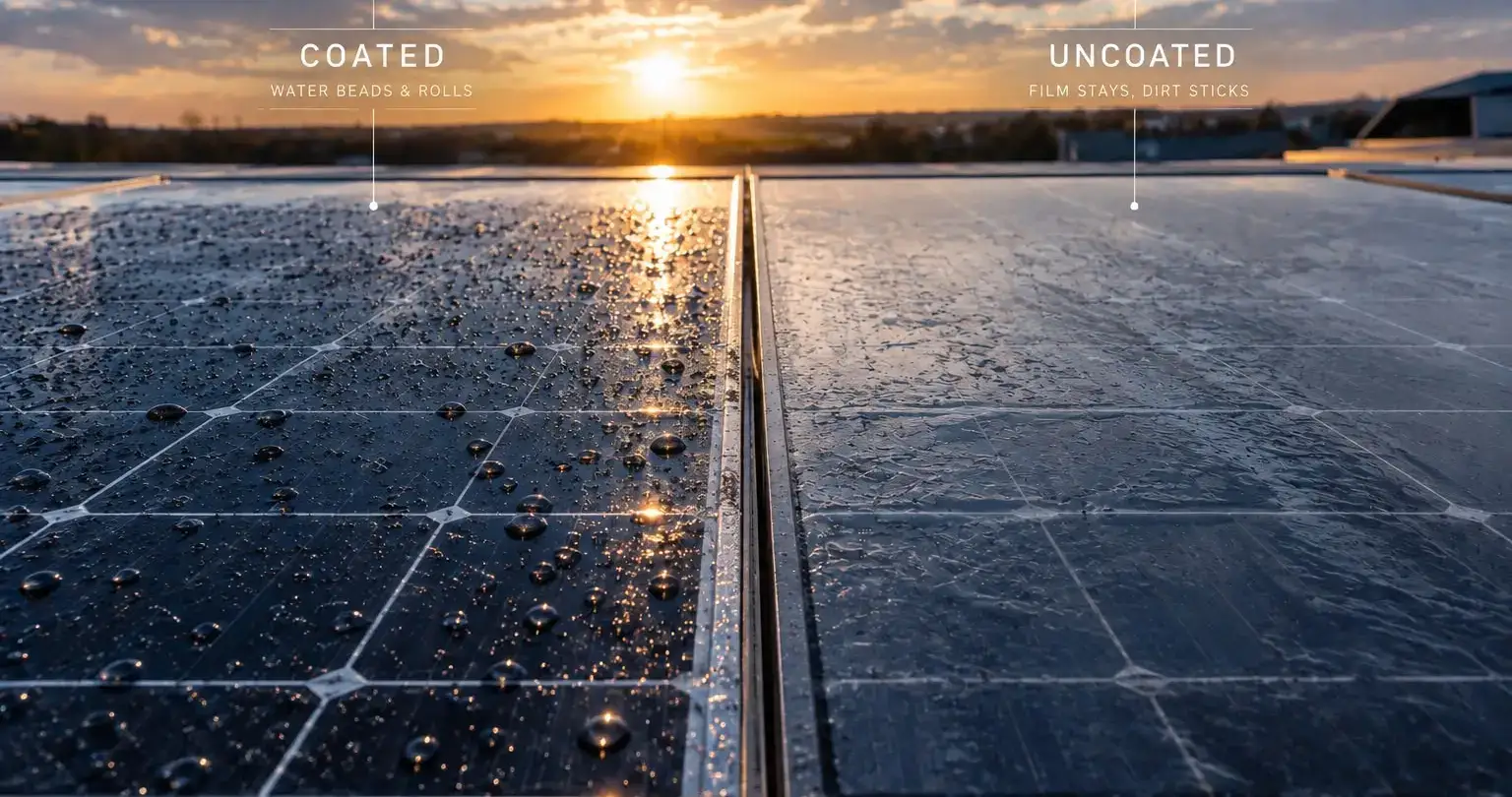
Two adjacent rooftop modules at sunrise: the coated one on the left holding water in discrete beads, the uncoated one on the right covered by a flat dirty film
Without ceramic coating

Microscopic irregularities let particles adhere to the glass. Incident light scatters off the rough, soiled surface instead of passing through, and transmittance drops.

With ceramic coating

A super-smooth, non-porous layer holds far less soiling and lets water bead cleanly away. More light passes through with minimal reflection, and rain does much of the cleaning.

Up to 30%Efficiency increase on heavily soiled arrays

Perfect Detailing's published figure, and it describes the recovery available on an array that has been left to soil badly — not a gain over a clean panel, which is not physically possible. The worked example further down this page uses a far more conservative 6% to 2.5% annualised soiling loss, which is what we have measured on monitored Highveld installations. We would rather quote you the conservative number and beat it.

Maximised light transmission

A smoother surface reduces reflection and scattering, increasing photon capture.

Easier to clean

Hydrophobic properties reject dirt, pollen and debris, allowing self-cleaning with rain.

Improved power output

Less soiling means more consistent generation across the year.

Long-term panel protection

The ceramic layer shields the glass from UV degradation and abrasion.

Better for the environment

Less water and chemical cleaning, and more energy from the same array.

What it is

A bonded silica layer, not a polish

The coating is a silicon-dioxide chemistry formulated for photovoltaic cover glass. Once applied it cross-links into a hard, transparent film measured in single-digit microns, bonded to the glass rather than resting on it. It does not tint, it does not haze, and it is engineered to stay optically neutral under constant ultraviolet load — which matters, because anything that shades a cell costs you generation.

  • High-transmission formulation designed for minimal light refraction
  • Anti-static, so airborne dust is actively discouraged from settling
  • Bonds to the cover glass, so it cannot be washed off like a wax
  • Rated for continuous UV exposure and roof-surface temperatures
  • Safe on anti-reflective coated glass when applied by trained hands
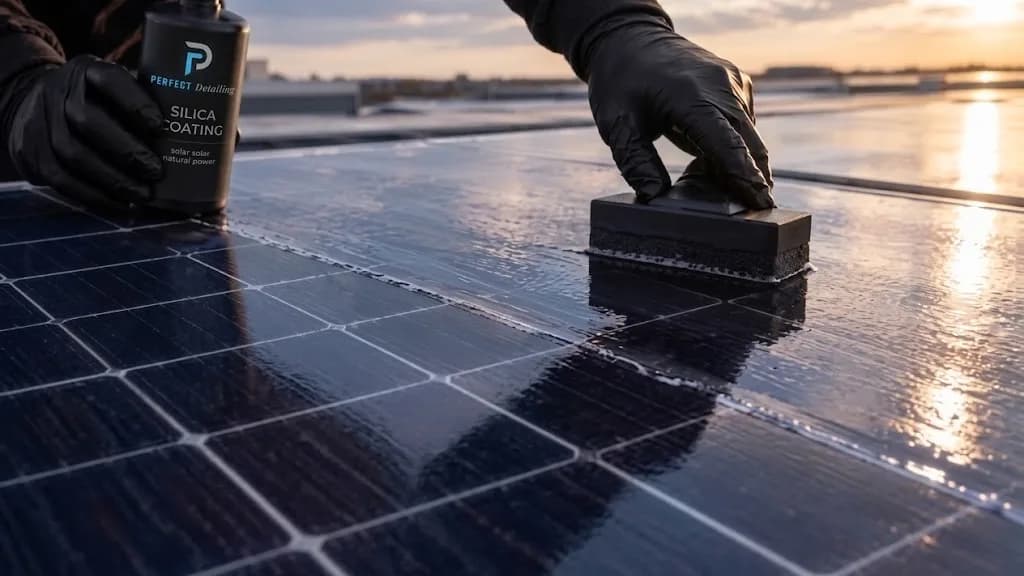
Gloved hands working Perfect Detailing silica coating across a solar module with a block applicator, the bottle standing on the panel alongside
How it works

Fewer places for dirt to hold on

Uncoated cover glass looks smooth but is microscopically porous and slightly textured. Dust settles into that texture, moisture wicks in behind it, and each wet-dry cycle cements the deposit a little harder. The ceramic layer fills and flattens the surface, then presents a low-energy face to the world: water pulls into beads instead of sheeting, and those beads carry loose soiling off the panel as they run.

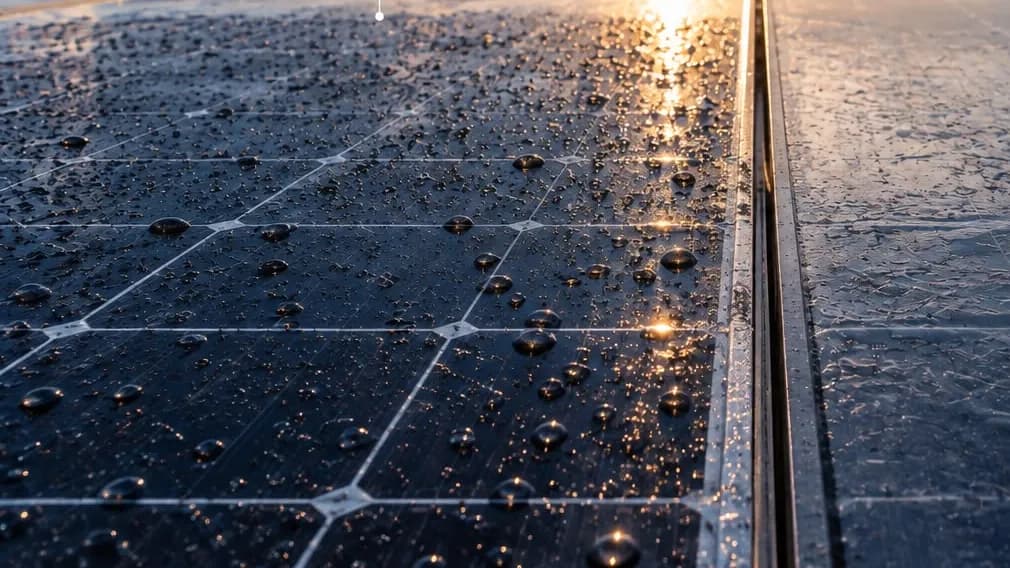
  • Contact angle rises past 110°, so water beads and rolls rather than pooling
  • Flattened surface gives airborne dust far less to key into
  • Dissolved minerals leave with the water instead of drying into scale
  • Organic soiling — bird droppings, sap, pollen — releases with a rinse
Water standing in discrete beads across a coated solar module at sunrise, the uncoated panel beyond it holding a flat film
The gain

Where the recovered energy actually comes from

There are two separate effects and it is worth keeping them apart. The first is soiling recovery: a coated panel accumulates less material between cleans, so its average annual loss is lower even though its peak clean output is unchanged. The second is cleaning efficiency: rain that used to leave a drying pattern of streaks and spots now clears the glass, which raises how often the array is effectively clean. Most of the money is in the first effect. We do not claim the coating makes a clean panel produce more than it was built to.

  • Annualised soiling loss typically falls from around 6% to under 3%
  • Rain events do more useful cleaning, extending time between paid visits
  • The array spends more of the year near its clean-state output
  • No claim of increased output from an already-clean panel — that is physics, not chemistry
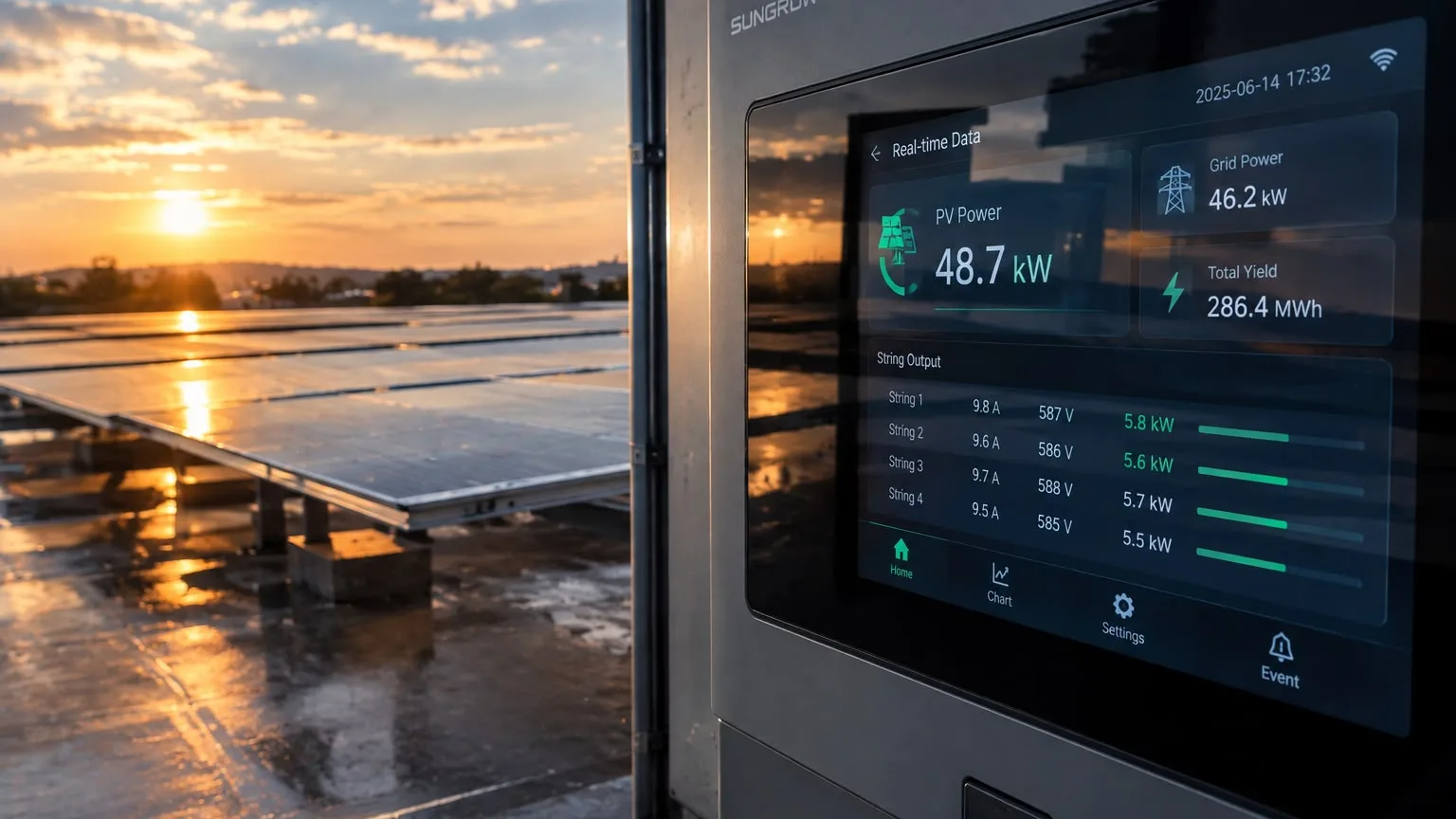
A rooftop inverter display reading 48.7 kW of PV power and 286.4 MWh of total yield, mounted beside the array it monitors
On the day

What our team does on your roof

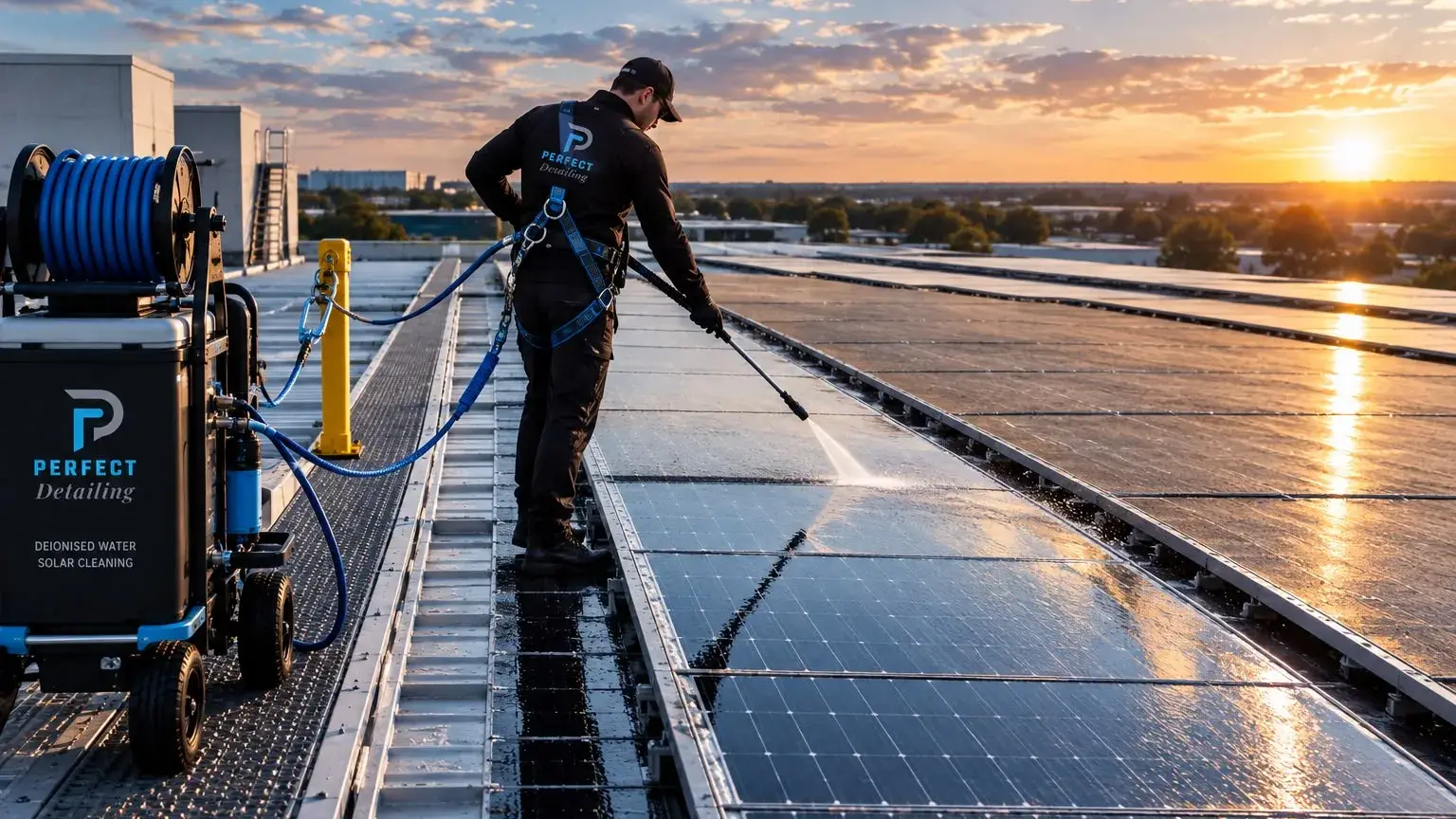
We arrive self-contained with deionised water, low-pressure delivery, roof-safe access equipment and fall protection. The array is washed and, where mineral scale has already etched in, treated to remove it before anything is coated — the coating locks in whatever it is applied over, so preparation is not optional. Panels are dried, wiped down with a solvent prep, then coated section by section, levelled and left to flash. Work is scheduled around the weather because the film needs a dry cure window.

  • Deionised water only — no spotting, no dissolved minerals left behind
  • Low pressure throughout; nothing that could compromise a frame seal or junction box
  • Isolation coordinated with your installer or facility team where required
  • Section-by-section application so no area cures before it is levelled
A Perfect Detailing technician walking a rooftop array at sunset, working from a deionised water cleaning rig parked on the walkway
Benefits

What changes on the roof.

Each of these is a mechanism, not a marketing line — and each is measurable on your own array.

≈3.5% recovered

Higher effective efficiency

Less material sitting between the sun and the cell means the array spends more of the year producing close to its clean-state output.

Anti-adhesion

Dirt struggles to bond

A flattened, low-energy surface gives dust, pollen and diesel particulate far less to key into, so deposits stay loose.

112° contact angle

Rain becomes a cleaning cycle

Water beads and runs off carrying loose soiling with it, rather than sheeting out and drying into a streaked mineral pattern.

Half the visits

Fewer paid cleaning visits

Most coated arrays move from quarterly cleaning to twice a year without losing ground on output.

5 year film

Longer glass life

A sacrificial ceramic layer takes the abrasion from wind-blown grit and repeat cleaning, instead of the cover glass taking it.

Rinse-and-go

Lower cleaning cost per clean

Contamination releases with a rinse and a light wipe, so cleans are quicker and need no aggressive chemistry or scrubbing.

If you do nothing

What an unprotected array quietly costs you.

None of this triggers an alarm. Output simply drifts downward while the maintenance line item drifts upward, and most owners find out years late.

Dust and pollen

Fine Highveld dust settles every dry-season day and cements down with each night of dew. It is the single largest cause of quiet output loss on a South African array.

2–6% output, continuously

Bird droppings

An opaque deposit does not dim a cell, it shuts it down. The bypass diode takes that section of the string out, and the loss is wildly out of proportion to the area covered.

Whole substring offline

Hard-water scale

Cleaning with municipal water leaves dissolved calcium behind. It dries into a haze that etches into the glass and eventually stops coming off with washing at all.

Permanent haze

Ultraviolet degradation

Constant UV attacks the encapsulant and any polymer surface treatment. Unprotected glass surfaces also micro-pit over time, giving dirt more to hold onto each year.

Accelerating soiling

Compounding production loss

Soiling loss is not a one-off. It runs every daylight hour of every year, and on a commercial array it is measured in tens of thousands of rand before anyone notices.

R9 600/year on 55 kWp

Rising cleaning cost

Once deposits have bonded, cleaning takes longer, needs stronger chemistry and has to happen more often — so the maintenance line item climbs every year.

2× cleaning frequency

Working assumptions

Here is exactly what the numbers below assume.

Published so you can argue with them. Substitute your own tariff and cleaning rate and the case either holds or it does not — we would rather you checked.

Panel rating

550 W

Typical of current residential and commercial modules

Specific yield

1 750 kWh/kWp

Gauteng, well-oriented, annual average

Electricity tariff

R2.85/kWh

Blended commercial rate — edit this for your own tariff

Cleaning rate

R28/panel

Typical contract cleaning cost per panel per visit

Soiling, uncoated

6.0%

Annualised average loss between quarterly cleans

Soiling, coated

2.5%

Annualised average loss on the same site once coated

The financial case

What 100 panels actually return.

A 55 kWp commercial array on the assumptions above. Every figure below is calculated from those inputs, not quoted from a brochure.

Annual return on a solar panel ceramic coating for a 100 panel array
Line itemAmount
Coating investment100 panels at R280 each, once− R28 000
Generation recovered each year3 369 kWh — soiling loss falls from 6.0% to 2.5%+ R9 601
Cleaning saved each year4 visits a year down to 2, at R28 per panel per visit+ R5 600
Total benefit each yearRecovered generation plus reduced cleaning+ R15 201
22 monthsPayback periodBefore the coating has paid for itself
R48 005Net gain over 5 yearsAfter deducting the full cost of the coating
171%Return on investmentAcross the 5 year service life

Dustier sites recover more; coastal and high-rainfall sites recover less. We will run this calculation on your actual tariff, panel count and cleaning contract before you commit to anything.

Packages

How it is packaged.

Every package starts with the same inspection. What differs is how far the correction goes and how long the protection is warranted for.

Residential rooftop

Typical home installation of eight to twenty-four panels, single storey or double.

R280per panel

Half a day

  • Pre-coating wash with deionised water
  • Mineral scale treatment where required
  • Full ceramic application and levelling
  • Cure supervision and post-coating beading test
  • Aftercare schedule and rinse guidance
Most requested

Commercial array

Office parks, warehousing, agricultural and body-corporate installations from fifty panels up.

R280per panel

One to three days on site

  • Site survey and access plan before the date
  • Isolation coordinated with your O&M provider
  • Section-by-section coating with progress sign-off
  • String-level before and after output snapshot
  • Written maintenance programme for the facility file

Installer partnership

Coating applied at commissioning, before the array has ever been soiled.

R280per panel

Aligned to your commissioning day

  • Coating applied to factory-clean glass — the ideal substrate
  • Scheduled alongside your commissioning team
  • Handover documentation branded for your client pack
  • Standing rate card for your project pipeline
On the day

Exactly how this job runs.

Tap any stage to see what happens inside it.

    • Panel count and layout confirmed against your quote
    • Baseline per-string output captured
    • Access, anchor points and isolation plan agreed
Expected lifespan

How long it holds

Expected service life
5 years

With the recommended rinse schedule and no abrasive cleaning

Time to full hardness
24 hours

Rain after cure is fine; heavy cleaning should wait a day

Recommended rinse
Quarterly

Plain water rinse in the dry season, less in the rainy months

Professional clean
Twice yearly

Down from the quarterly cycle most uncoated arrays need

Living with a coated array

A coated array is easier to look after, not maintenance-free. The coating's job is to make cleaning quick and infrequent — it is not a reason to stop looking at the roof.

  • 01Rinse with plain water in the dry season; let the rain handle the wet months
  • 02Never use abrasive pads, scouring powder or high-pressure lances on cover glass
  • 03Avoid cleaning in full midday sun — water dries before it can run off
  • 04Book a professional clean twice a year and let us check the beading while we are up there
  • 05Send us a photo if you see a patch that stops beading — spot repairs are inexpensive
Questions

Solar Coating, answered.

All questions
  • R280 per panel, which covers preparation, the coating itself and cure supervision. There is no separate call-out on standard rooftop arrays at accessible height. Difficult access, heavy pre-existing mineral scale needing treatment, and ground-mount arrays are quoted after a site visit.

Next step

Ready to talk about solar coating?

Send us the details and you will have a written, itemised quote within one working day.