Skip to content

Premium vehicle detailing, paint correction and ceramic coating

Architectural glazing · High-rise & residential

Glass is the one building material nobody maintains until it is ruined.

Facade glass takes rain, irrigation overspray, airborne dust and constant ultraviolet, and almost nothing is done about it until the panes look permanently dirty. By that point the damage is usually in the glass rather than on it. A ceramic coating changes the surface so contamination cannot bond, rain runs clear instead of streaking, and the heat coming through the pane drops.

Coated architectural glazing with rain running clear off the panePD
15%
Reduced cooling costs

Published figure, up to — see the qualifier below

5yrs
Coating service life

On vertical glazing in normal exposure

0%
Visible tint added

Optically clear — daylight is not traded away

The difference

Two panes, the same weather, a different result.

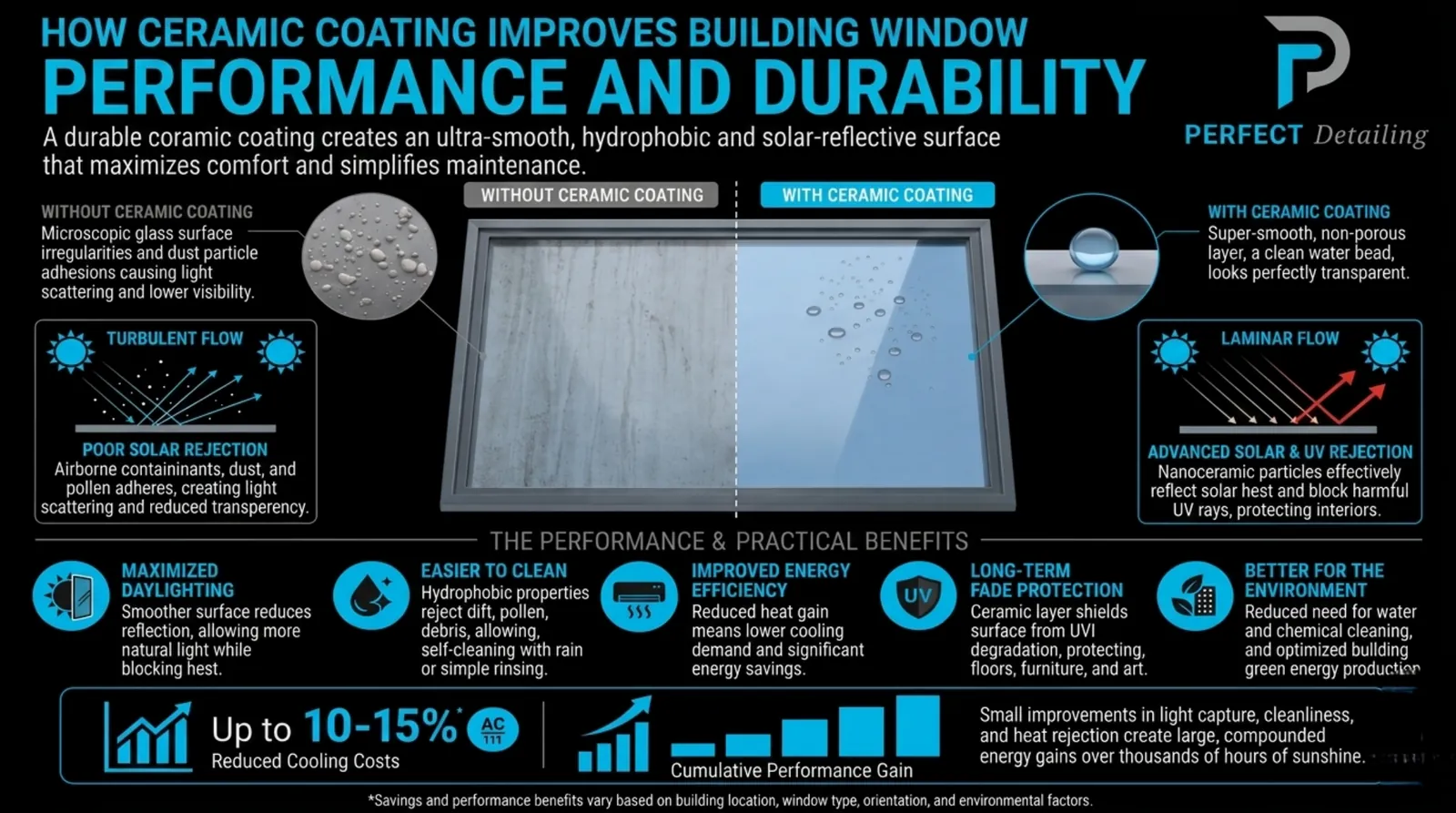
The mechanism is the same one that makes a coated solar module produce more: a flatter, non-porous surface scatters less light and holds less dirt. On a building it buys daylight and comfort instead of generation.

Split comparison of building glazing with and without ceramic coating, showing solar and UV rejection against light scattering and dust adhesion
Without ceramic coating

Microscopic surface irregularities let airborne contaminants, dust and pollen adhere. Light scatters, transparency drops, and solar heat passes straight through into the space.

With ceramic coating

A super-smooth, non-porous layer keeps the pane clear and lets water bead away cleanly, while nanoceramic particles reflect solar heat and block ultraviolet before it enters.

Up to 10–15%Reduced cooling costs

Perfect Detailing's published figure. Savings vary based on building location, window type, orientation and environmental factors — an elevation in full afternoon sun behaves very differently from a shaded one, and we would rather survey your building than quote you an average.

Maximised daylighting

Less reflection and scattering, more usable natural light.

Easier to clean

Self-cleaning with rain or a simple rinse.

Improved energy efficiency

Reduced heat gain lowers cooling demand.

Long-term fade protection

Shields floors, furniture and stock from UV.

Better for the environment

Less water and chemical cleaning, lower energy use.

What it is

A specially formulated coating for glazing, not a film

This is not window tint and not an applied film. It is a liquid silica chemistry formulated for architectural glass that bonds into the surface and cross-links, leaving a hard, transparent, non-porous layer. Nothing is stuck on that can bubble, peel at the edge or discolour, and the glass keeps its optical clarity because the coating is measured in microns and is optically neutral.

  • Bonded into the glass surface, not adhered on top of it
  • Nothing to bubble, peel or lift at the edges over time
  • Optically clear — no tint, no haze, no loss of daylight
  • Suitable for high-rise curtain walling and residential glazing alike
A specially formulated coating for glazing, not a film
Self-cleaning

Rain stops leaving a pattern behind

Uncoated glass is microscopically porous. Water spreads across it, dries in place and leaves the dissolved minerals it was carrying behind as a streak. On a coated pane the water pulls into beads and runs off under its own weight, carrying loose dust with it and leaving very little behind to dry. The practical result is that ordinary rain does most of the cleaning, and the building looks presentable for far longer between visits.

  • Water beads and sheets off instead of drying in place
  • Non-streaking rain flow — the difference is visible after the first storm
  • Dust, pollen and airborne grime have far less to key into
  • Fewer cleaning visits needed to keep a facade looking maintained
Rain stops leaving a pattern behind
Solar heat gain

The cooling load through a window is a running cost

A large glazed elevation facing the sun is, in cooling terms, a heater. Nanoceramic particles in the coating reflect a meaningful portion of solar heat and block ultraviolet, so less of that energy arrives inside as heat the air conditioning then has to remove. On a commercial building with a big glass envelope, that shows up on the electricity account rather than in a comfort survey.

  • Reflects a portion of incoming solar heat before it enters the space
  • Blocks ultraviolet, which is what fades floors, furniture and artwork
  • Reduces the cooling demand a large glazed elevation creates
  • Achieved without darkening the glass or reducing daylight
The cooling load through a window is a running cost
Hard water & etching

The damage that cannot be cleaned off

Irrigation overspray and repeated cleaning with municipal water are the two things that permanently ruin glass. Dissolved calcium dries onto the pane, and every wet-dry cycle bonds it harder until it is chemically etched into the surface. At that point no amount of washing will remove it — the haze is in the glass. A coating prevents the deposit from bonding in the first place, which is the only real defence.

  • Hard water spots are prevented rather than removed later
  • Irrigation overspray stops etching a permanent pattern into the pane
  • Existing light etching can often be polished out before coating
  • Extends the usable life and clarity of the glazing itself
The damage that cannot be cleaned off
Benefits

What you get out of it.

No tint

Maximised daylighting

A smoother surface reduces reflection and scattering, so more natural light comes through while heat is blocked.

Self-cleaning

Easier to clean

Dirt, pollen and debris release with rain or a simple rinse instead of needing detergent and effort.

Energy saved

Lower cooling demand

Reduced solar heat gain means the air conditioning works less on the elevations that catch the sun.

UV blocked

Fade protection

Ultraviolet rejection protects floors, furniture, stock and artwork sitting behind the glass.

Permanent damage avoided

Etch prevention

Hard water and irrigation overspray stop bonding into the glass, which is damage that cannot be undone.

5 year film

Longer glass life

A sacrificial layer takes the abrasion of repeat cleaning instead of the pane taking it.

Packages

How it is packaged.

Every package starts with the same inspection. What differs is how far the correction goes and how long the protection is warranted for.

Residential glazing

Homes and estates, particularly where irrigation reaches the glass.

Quoted per square metre

One to two days

  • Glass condition assessment
  • Deep clean and mineral deposit removal
  • Light etch polishing where recoverable
  • Ceramic coating on all treated panes
  • Aftercare guidance
Most requested

Commercial facade

Office parks, retail and low-rise commercial elevations.

Quoted after building survey

Phased by elevation

  • Building survey with elevation-by-elevation assessment
  • Access and safety plan agreed with the facility team
  • Deep clean, deposit removal and coating
  • Phased by elevation to keep the building operating
  • Documentation for the facility maintenance file

High-rise curtain walling

Rope access and cradle work on tall glazed envelopes.

Quoted after survey

Programme agreed per building

  • Access method agreed with your building manager
  • Certified access partners where rope or cradle work is required
  • Coating applied in a planned sequence
  • Maintenance cycle costed for the building's budget
  • Annual inspection included
On the day

Exactly how this job runs.

Tap any stage to see what happens inside it.

    • Elevation-by-elevation condition record
    • Existing etching identified and separated from surface soiling
    • Access and safety requirements agreed
Expected lifespan

How long it holds

Coating on vertical glazing
4–5 years

Normal exposure, cleaned as recommended

Coating on sloped or skylight glass
3–4 years

Shorter, because the exposure is far harsher

Full hardness
24 hours

Rain after cure is fine; heavy cleaning should wait a day

Professional clean
Twice yearly

Down from the quarterly cycle most facades need

Looking after coated glazing

Coated glass needs less attention, but the way it is cleaned still decides how long the coating lasts.

  • 01Rinse with clean water; a pH-neutral glass cleaner where more is needed
  • 02Never use abrasive pads, scrapers or scouring powder on coated glass
  • 03Redirect irrigation away from the glass — it is the leading cause of permanent etching
  • 04Tell your cleaning contractor the glass is coated, and give them the aftercare sheet
  • 05Book the annual inspection so we can check the beading and spot-repair if needed
Questions

Architectural Glass, answered.

All questions
  • No. Tint is a film adhered to the glass that can bubble, peel and discolour, and it darkens the pane. This is a liquid ceramic chemistry that bonds into the glass surface itself. It is optically clear — you do not lose daylight — and there is nothing stuck on to fail later. It rejects solar heat through nanoceramic particles rather than by blocking visible light.

Next step

Ready to talk about architectural glass?

Send us the details and you will have a written, itemised quote within one working day.