Skip to content

Premium vehicle detailing, paint correction and ceramic coating

Leather · Fabric · Trim · Glass · Odour

The half of the car you actually spend your time inside.

Exterior work is what other people see. The interior is what you see, touch and breathe every day — and it is the part that ages fastest, because it lives under ultraviolet light, body oils, spilled coffee, dog hair and the friction of getting in and out ten thousand times. Restoring one is patient, methodical work with a lot of different chemistry, done in an order that stops each step undoing the last.

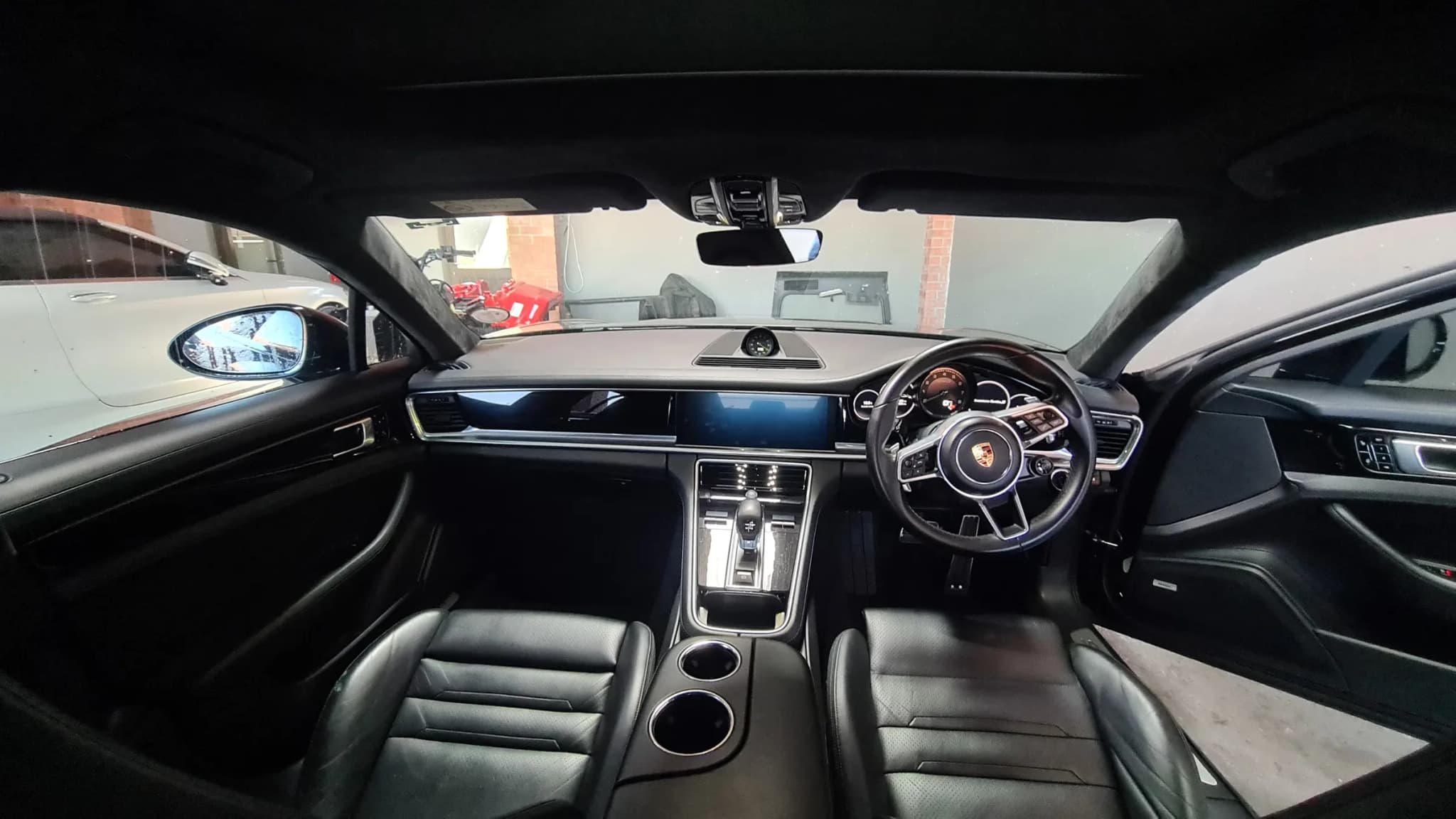
The full cabin of a Porsche Panamera photographed from the rear after a complete interior detail
6hrs
Typical full interior

On a five-seat car in ordinary condition

12mths
Fabric and leather guard

Re-applied at each maintenance service

60°C
Extraction temperature

Hot water lifts what cold shampoo leaves behind

The order of operations

Top down, dry to wet — or you will do it twice

Everything in a cabin falls. Clean the seats before the headliner and you will be cleaning the seats again. So we work from the roof down and from dry methods to wet ones: headliner, pillars and vents first, then switchgear and console, then seats, then carpets last of all. Dry extraction — compressed air, soft brushes and a vacuum working together — pulls out grit and hair before any liquid is introduced, because water turns dust into mud and pushes it deeper into the weave.

  • Headliner, pillars, vents and roof console before anything below them
  • Compressed air and soft detailing brushes through seams, rails and switchgear
  • Grit and hair lifted dry, so no liquid ever turns dust into mud
  • Carpets and mats last, when nothing above them can drop onto the result
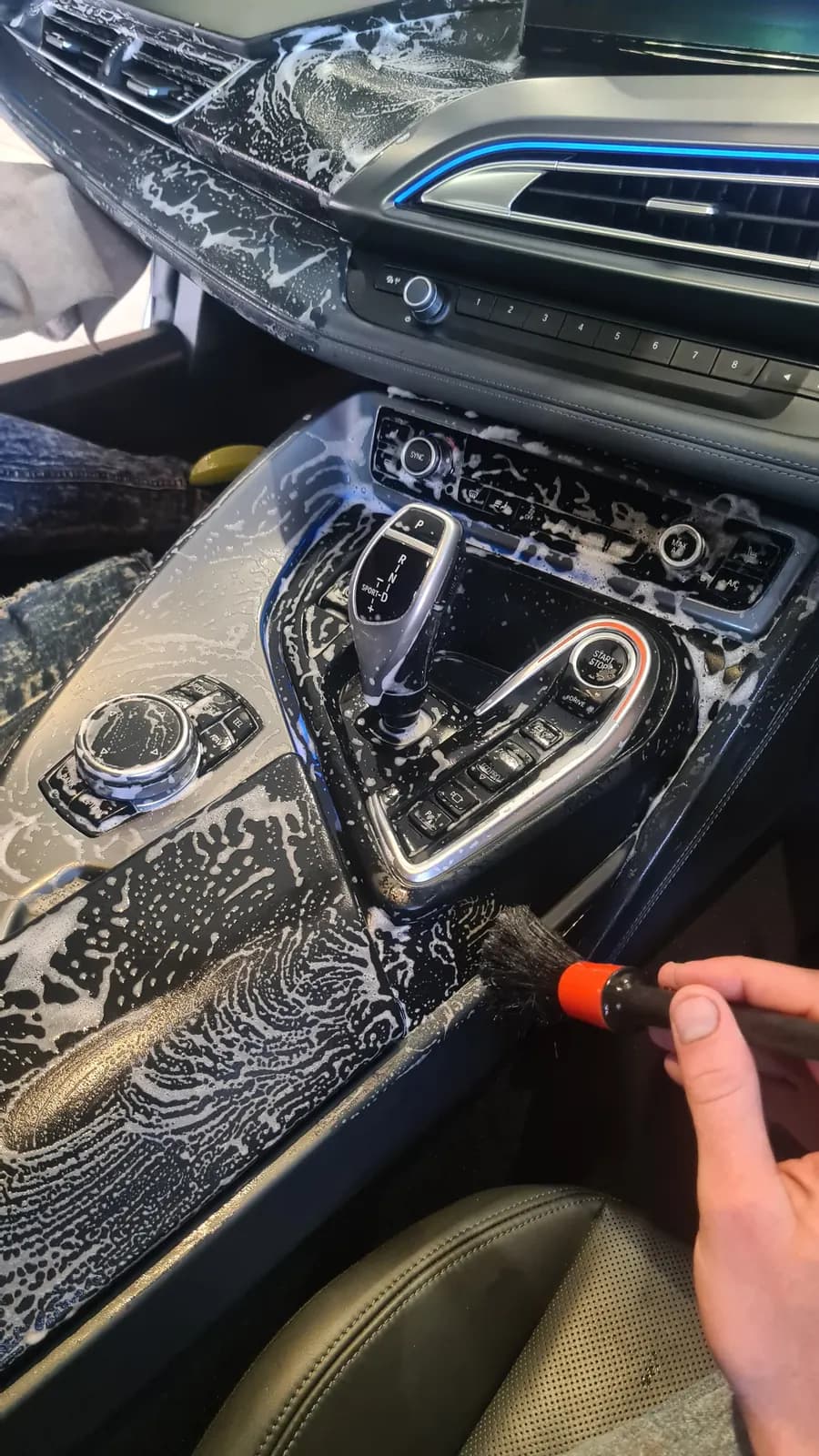
A detailing brush working foam through the switchgear of a car console
Brush and foam through the switchgearPD
Fabric, carpet and Alcantara

Hot-water extraction removes what shampoo only rearranges

A wet-vac and a bottle of upholstery cleaner move soiling around. Extraction removes it: hot solution is injected into the fibre under pressure and pulled straight back out with the dirt suspended in it, repeatedly, until the recovery water runs clear. That is the difference between a seat that looks better and a seat that is actually clean — and it is why the smell goes with it, because the smell was living in what came out. Alcantara and suede are treated differently again: low moisture, soft brush, and brushed back to a uniform nap while damp so it dries even.

  • Hot-water extraction on seats, carpets, boot and mats until recovery runs clear
  • Pre-treatment dwelled on stains before extraction rather than scrubbed after
  • Alcantara and suede cleaned low-moisture and re-napped while damp
  • Forced-air drying so nothing is handed back damp under the foam
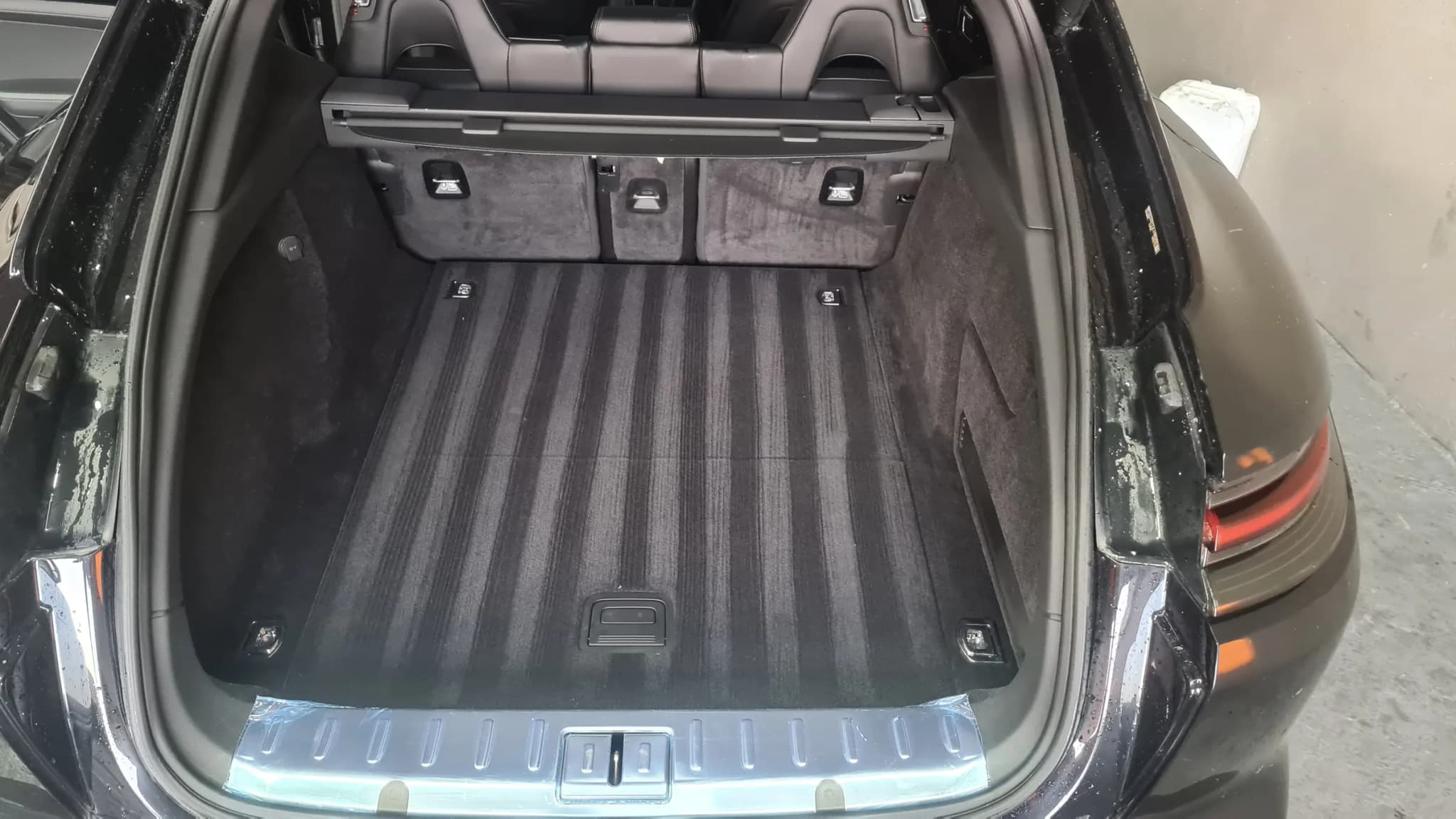
The boot floor and carpet of a Porsche Panamera after hot-water extraction, the pile lifted and even
Extracted, dried, re-nappedPD
Leather

Cleaned in the grain, conditioned matte, never dressed to a shine

Almost all modern automotive leather is pigmented — a coloured, protective film over the hide. Soiling does not sit on top of it, it collects in the grain and at the seams, which is why a wipe with a cloth takes off the surface and leaves the pattern. We work a pH-appropriate cleaner into the grain with a soft brush, lift it out rather than spread it, then condition with something that feeds the finish and dries matte. If a cabin comes back glossy and slippery, it has been dressed, not cleaned — and that shine is a silicone film that attracts dust and glares in the windscreen.

  • pH-appropriate cleaner agitated into the grain with a soft brush, not a cloth
  • Perforations cleaned without flooding the foam beneath them
  • Seams, piping and bolsters worked individually — where wear actually shows
  • Conditioned to a factory matte finish, never a wet-look dressing
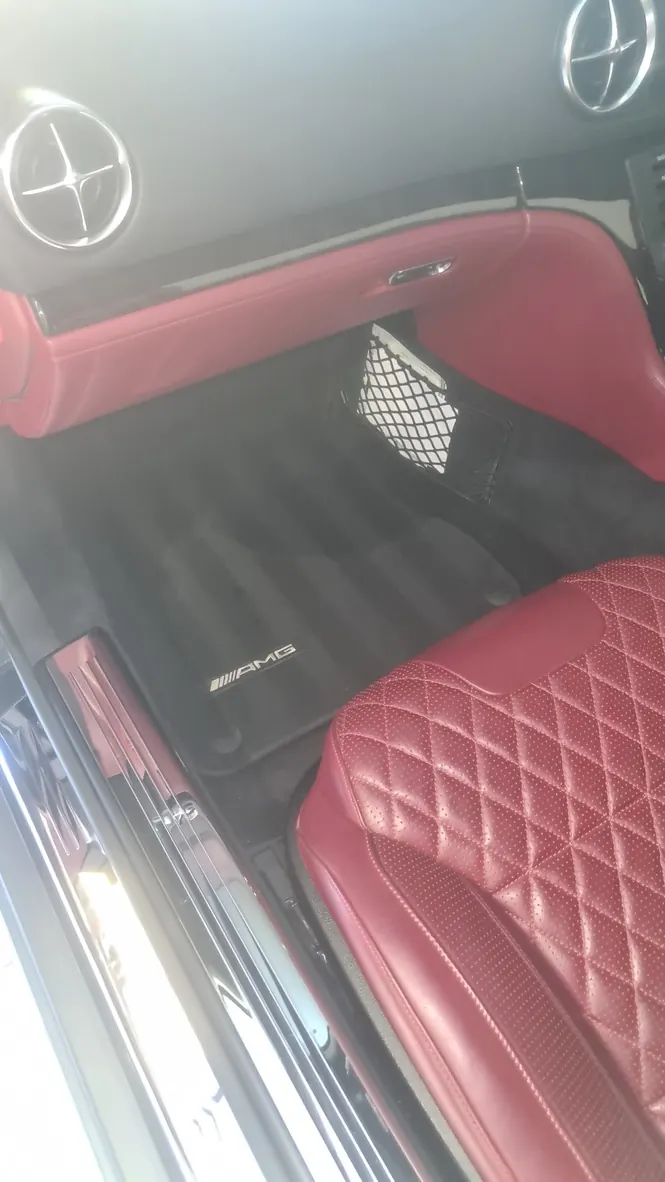
The red quilted leather cabin of a Mercedes-AMG SL 65 after cleaning and conditioning
Cleaned in the grain, conditioned mattePD
Plastics, trim and switchgear

The surfaces your hands are on all day

Steering wheel, gear selector, door pulls, indicator stalks, the rim of the cupholder — these carry body oils and sunscreen and go glazed and slightly tacky long before anything else in the cabin does. They need degreasing, not dressing. Textured plastics get brushed so the cleaner reaches the bottom of the texture instead of skating over it. Piano-black trim, which scratches if you look at it wrongly, is cleaned with dedicated media and can be machine-refined where it has already been marked. Everything is finished with an ultraviolet protectant that leaves a satin surface, because a glossy dashboard reflects straight into the windscreen.

  • High-touch surfaces degreased, not dressed over
  • Textured plastics brushed so the cleaner reaches the base of the grain
  • Piano-black and gloss trim refined where marred, then protected
  • UV protectant left satin — no glare on the windscreen, no greasy feel
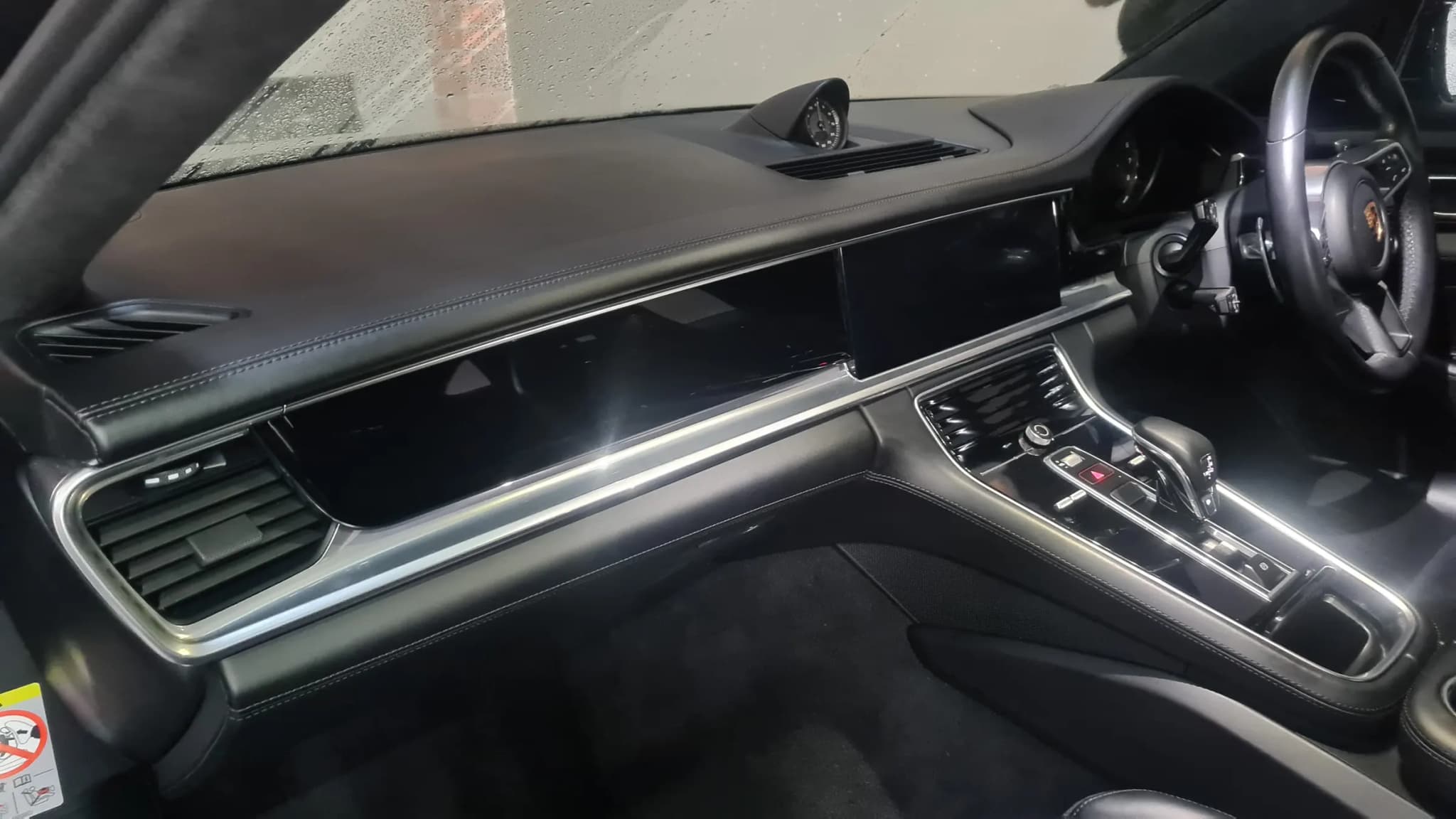
A cleaned Porsche dashboard, centre console and switchgear photographed from the passenger side
Satin, not glossyPD
Odour

Smell is a source, not a scent

Air fresheners do not remove odour, they add a second one. Odour in a cabin lives somewhere specific: spilled milk under a seat rail, damp in the carpet underlay, cigarette residue on the headliner and glass, a blocked air-conditioning drain feeding mould on the evaporator. We find the source, remove it, and only then treat the air path. Where an odour is genuinely embedded we can follow up with an ozone or chlorine-dioxide treatment, which oxidises what is left in the ducting rather than covering it.

  • Source located and removed before anything is treated
  • Carpet underlay lifted and dried where damp has got underneath
  • Cabin filter replaced and the evaporator treated through the air path
  • Ozone or chlorine-dioxide treatment available for embedded smoke and mould
Smell is a source, not a scent
Glass, last of all

The inside of a windscreen holds a film nobody thinks about

Plasticisers off-gas out of a hot dashboard and condense on the inside of the windscreen as an oily haze. You never notice it until you drive into low sun and cannot see. It is cleaned last, after every other product in the cabin has been used, with a two-towel method — one to cut the film, one to buff dry — and finished edge to edge so there is no line where the glass meets the seal. Interior glass coating is available to slow the haze building back up.

  • Cleaned last, after every other product has been applied
  • Two-towel method — one cuts the film, one buffs it dry
  • Worked to the very edge, including under the seals
  • Optional interior glass coating to slow re-hazing
The inside of a windscreen holds a film nobody thinks about
Keeping it

Protection so the next spill is an incident, not a stain

A restored interior is worth protecting for exactly the reason a corrected panel is: it is now at its best, and everything from here is downhill unless you intervene. Fabric guard puts a hydrophobic layer around each fibre so a spill beads on top long enough to be lifted rather than wicking into the foam. Leather guard does the same for pigmented hide, and slows dye transfer from denim — the single most common thing that ruins a light-coloured cabin. Both are re-applied at every maintenance service, which is included in a plan.

  • Fabric and carpet guard — spills bead and can be lifted instead of wicking in
  • Leather guard slows dye transfer from denim onto light hide
  • UV protectant on every plastic and vinyl surface that sees sun
  • Re-applied at each maintenance service, and included in a plan
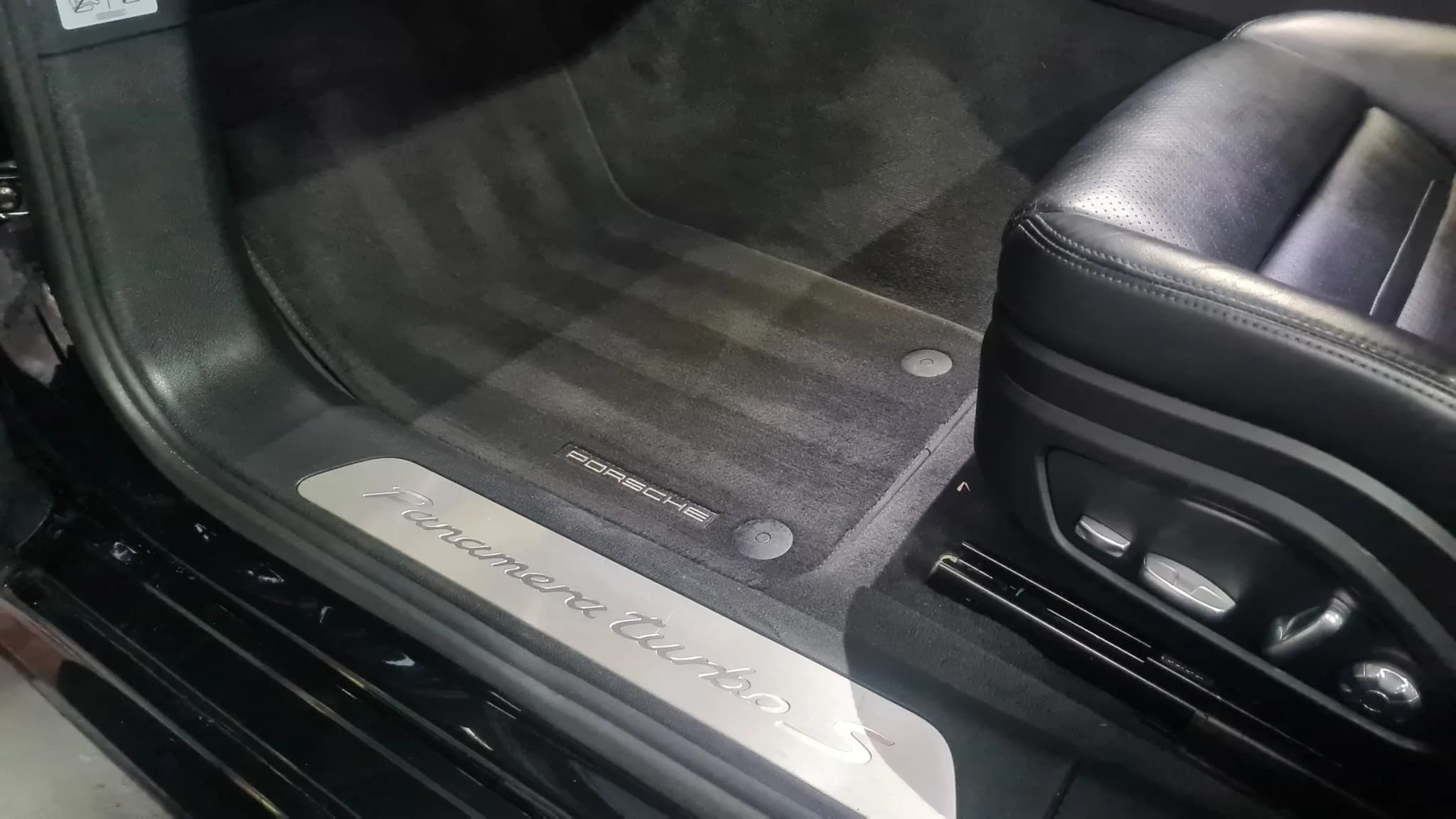
A cleaned Porsche door sill, seat base and floor mat after protection was applied
Finished and protectedPD
Benefits

What you get out of it.

At source

Clean, not perfumed

Extraction removes what was causing the smell. Nothing is sprayed over the top of anything.

Factory matte

Leather that lasts

Cleaning in the grain and conditioning matte keeps the pigmented finish intact — which is what actually stops cracking.

Satin finish

No glare, no grease

Satin UV protection on every plastic surface. Nothing reflects into the windscreen, nothing feels tacky in summer.

Air path treated

Healthier air

Cabin filter, air path and evaporator treated, not just the surfaces you can see.

12 months

Spills stop being disasters

Guarded fabric holds a spill on the surface long enough for you to lift it before it reaches the foam.

Value held

It shows at resale

Buyers forgive a stone chip. They do not forgive a stained driver's seat or a cabin that smells of dog.

Packages

How it is packaged.

Every package starts with the same inspection. What differs is how far the correction goes and how long the protection is warranted for.

Interior Refresh

For a cabin in good condition that needs resetting rather than rescuing.

Quoted by vehicle size

2–3 hours

  • Full dry extraction — air, brushes and vacuum through every seam
  • All hard surfaces cleaned and UV protected
  • Leather cleaned and conditioned
  • Interior glass, two-towel method
  • Cabin filter checked and reported
Most requested

Full Interior Detail

The complete restoration. Our most common interior booking.

Quoted by vehicle size and condition

5–7 hours

  • Everything in the Interior Refresh
  • Hot-water extraction on seats, carpets, boot and mats
  • Leather cleaned in the grain, seams and perforations worked individually
  • Piano-black and gloss trim refined where marred
  • Odour source located, removed and the air path treated
  • Fabric and leather guard applied

Restoration & Decontamination

Heavily soiled, smoked-in, flood-damp or long-neglected cabins.

Quoted after inspection — condition varies enormously

1–2 days

  • Everything in the Full Interior Detail
  • Seats removed where access requires it
  • Carpet underlay lifted, cleaned and force-dried
  • Ozone or chlorine-dioxide treatment for embedded odour
  • Cabin filter replaced and evaporator treated
  • Headliner cleaned low-moisture, at your risk and ours agreed in writing
On the day

Exactly how this job runs.

Tap any stage to see what happens inside it.

    • Existing damage, burns and tears photographed
    • Trim condition assessed before any product is used
    • Achievable result agreed — some stains are dye, not soiling
Expected lifespan

How long it holds

The clean itself
Permanent

What has been extracted is gone. What happens next is ordinary use

Fabric and carpet guard
12 months

Or one deep extraction, whichever comes first

Leather guard
9–12 months

Shorter on bolsters and the driver's seat, where friction is highest

UV protectant on trim
3–4 months

Re-applied at every maintenance service

Keeping an interior right

Interiors degrade gradually and invisibly, which is why people only notice when it is a restoration job again. A short interior service on the same cycle as your exterior maintenance keeps it permanently at the standard it was handed back at, for a fraction of what recovering it costs.

  • 01Vacuum weekly — grit underfoot is what abrades carpet and sill trim
  • 02Lift spills immediately; guarded fabric buys you minutes, not hours
  • 03Keep a plain microfibre in the door bin for the wheel and selector
  • 04Never use an all-purpose cleaner on leather, and never a silicone dressing on the wheel
  • 05Cabin filter every 15 000 km — most of what you smell arrives through it
  • 06An interior service at each maintenance detail, included in a plan
Questions

Interiors, answered.

All questions
  • Usually, but not always, and the honest answer depends on whether it is soiling or dye. Coffee, milk, mud and body oils are soiling and come out with hot-water extraction. Ink, dye transfer from denim on light leather, sun-bleached patches and anything that has actually altered the colour of the fibre are not soiling — they are a change to the material. We tell you which one you have before we start, and we never promise a stain we cannot see the back of.

Next step

Ready to talk about interiors?

Send us the details and you will have a written, itemised quote within one working day.