Skip to content

Premium vehicle detailing, paint correction and ceramic coating

Paint · Glass · Wheels · Trim

Wax sits on paint. Ceramic becomes part of it.

A ceramic coating is a liquid silica polymer that cross-links into a hard, transparent film chemically bonded to your clear coat. It is not a shine you top up every few months — it is a sacrificial surface that takes the chemical and ultraviolet punishment your paint would otherwise absorb.

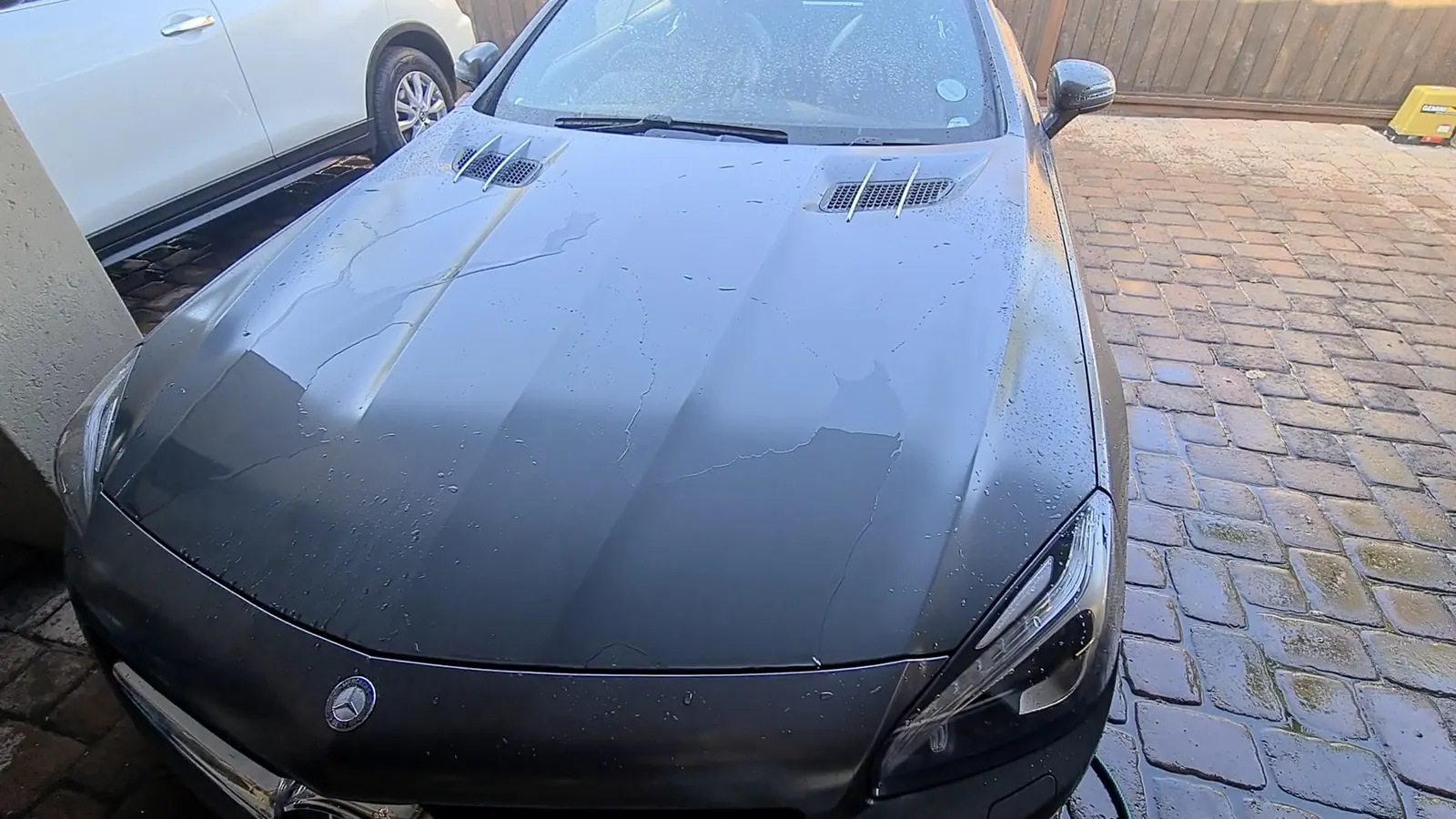
The coated bonnet and wing of a Mercedes-AMG SL 65, the surface returning one clean reflection
9H
Pencil hardness

Cured film hardness on the standard scale

112°
Contact angle

Measured on a coated panel after full cure

5yrs
Typical service life

Tiered by system, stated in your warranty

Coated vs uncoated

What the water is actually telling you.

Beading is not a party trick — it is the visible readout of how much surface area water is sharing with your paint. Switch the surface and watch what changes.

Contact angle

Water beads, runs, and takes the dirt with it.

Contact angle112°
A cross-section, drawn to the angles we actually measure. The steeper the bead, the less surface area the water shares with your paint — and the less of what is dissolved in it gets left behind when it dries.
The difference

Half a bonnet tells the whole story.

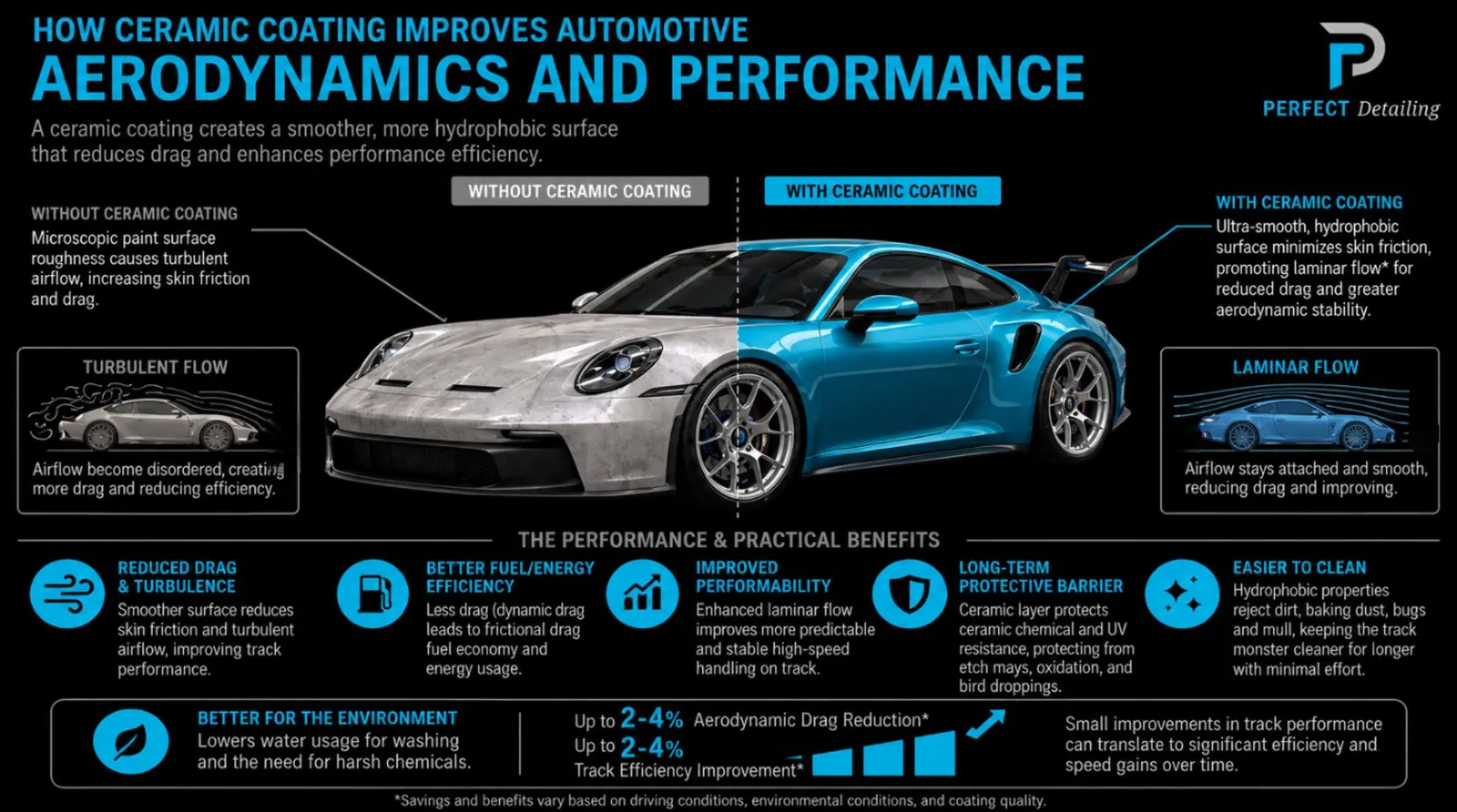
Paint that looks smooth is not. At the scale airflow cares about, uncorrected clear coat is a landscape of peaks and valleys, and every one of them trips the air passing over it.

Split comparison of a car with and without ceramic coating, showing laminar airflow against turbulent airflow and the resulting drag difference
Without ceramic coating

Microscopic paint surface roughness causes turbulent airflow, increasing skin friction and drag — and giving contamination somewhere to bond while it does.

With ceramic coating

An ultra-smooth, hydrophobic surface minimises skin friction and promotes attached flow, for lower drag and greater aerodynamic stability at speed.

Up to 2–4%Aerodynamic drag reduction

Perfect Detailing's published figure, alongside up to 2–4% track efficiency improvement. Savings and benefits vary based on driving conditions, environmental conditions and coating quality. On a road car this is a bonus rather than a reason to book — the reasons to book are the chemical resistance, the UV stability and the wash that takes half as long.

Reduced drag & turbulence

A smoother surface lowers skin friction and turbulent airflow.

Better energy efficiency

Less dynamic drag contributes to fuel economy and energy use.

More predictable handling

Attached flow supports stable behaviour at sustained high speed.

Long-term protective barrier

The ceramic layer takes chemical attack, UV, etching and bird droppings.

Easier to clean

Hydrophobic properties reject dirt, dust and bugs with far less effort.

What it is

Chemistry, not a product on a shelf

The coating arrives as a solvent-carried silicon dioxide resin. Applied to clean, bare clear coat it flashes off its carrier and cross-links — silicon and oxygen forming a lattice that keys into the microscopic texture of your paint. What is left is a few microns of glass-like film with its own hardness, its own chemical resistance and its own surface energy, sitting above your clear coat and taking the abuse first.

  • Multi-layer nanotechnology application creating a 9H hardness glass barrier
  • Bonds chemically to clear coat rather than sitting on it like wax
  • Bonds equally to paint, metal and glass, so wheels and windows are covered too
  • Optically clear — it deepens gloss without adding colour
  • Removable only by machine abrasion, not by washing or solvent
Chemistry, not a product on a shelf
Chemical resistance

The things that etch paint stop reaching it

Bird droppings are acidic and hot enough in Highveld sun to etch clear coat within hours. Bug residue, tree sap, industrial fallout, brake dust and the alkaline detergents at automated washes all attack a paint surface chemically. A cured ceramic film resists a far wider pH range than clear coat does, so those attacks land on a sacrificial layer instead.

  • Broad pH stability — resists both acidic fallout and alkaline detergent
  • Bird and insect etching prevented if removed within a reasonable window
  • Iron fallout and brake dust rinse away instead of embedding
  • Fuel spill at the filler neck wipes off rather than staining
The things that etch paint stop reaching it
UV protection

Oxidation is a slow fire. This is the blanket.

South African ultraviolet load is punishing. Clear coat contains UV absorbers that deplete over years; once they are gone, oxidation begins, pigment fades and single-stage reds and blacks chalk. A ceramic film is UV-stable and absorbs the exposure that would otherwise consume your clear coat's own protection, which is why coated cars hold their colour and their gloss far longer.

  • Shields clear coat's UV absorbers from depletion
  • Slows oxidation, chalking and pigment fade
  • Particularly valuable on reds, blacks and matte finishes
  • Also stabilises coated plastic trim, which is where fade shows first
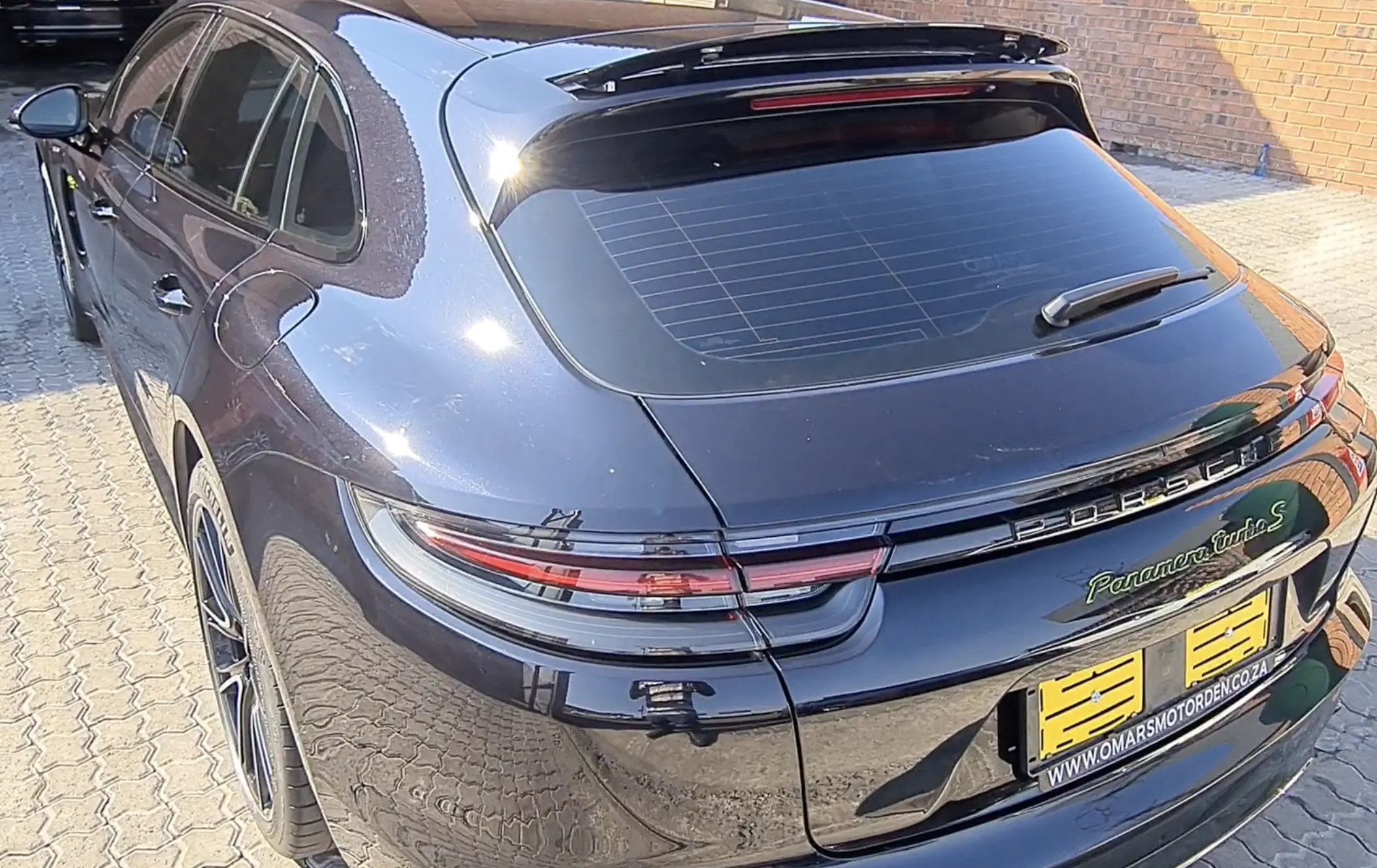
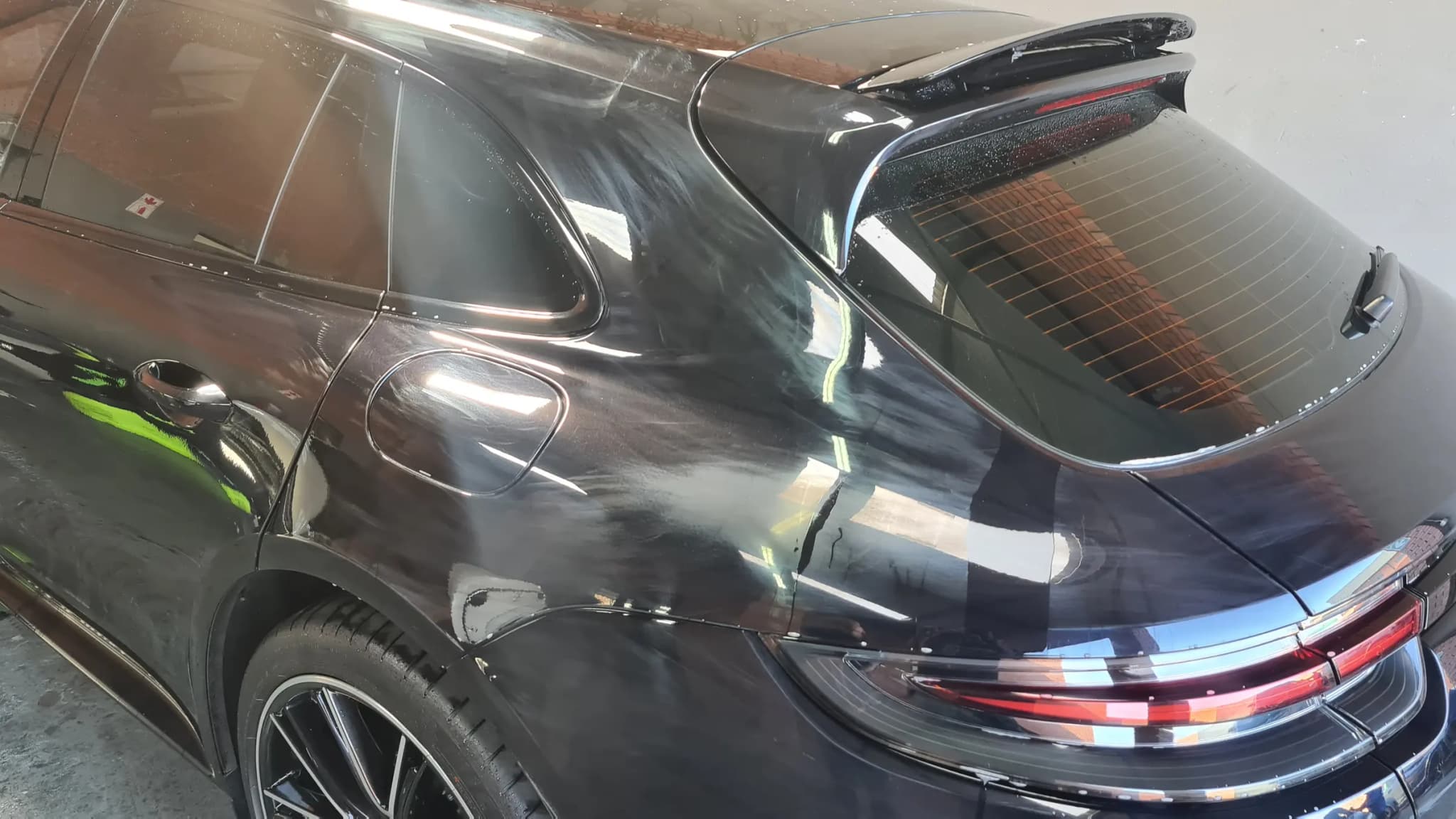
A coated black Porsche flank returning the yard behind it without distortion
Coated flank, twelve months onPD
Hydrophobic behaviour

Why the water looks like that

Surface energy decides whether water spreads out or pulls into beads. Ceramic drops the paint's surface energy far enough that water contracts into tight, high-contact-angle beads which run off under their own weight, dragging loose dirt with them. This is not cosmetic — it is why a coated car comes out of a rainstorm cleaner than it went in, and why it dries without a water spot.

  • Contact angle above 110° — water beads tightly and self-releases
  • Self-cleaning effect in rain; far less road film retained
  • Drying is faster with less mechanical contact, so fewer wash marks
  • Mineral spotting is reduced because water leaves rather than evaporating in place
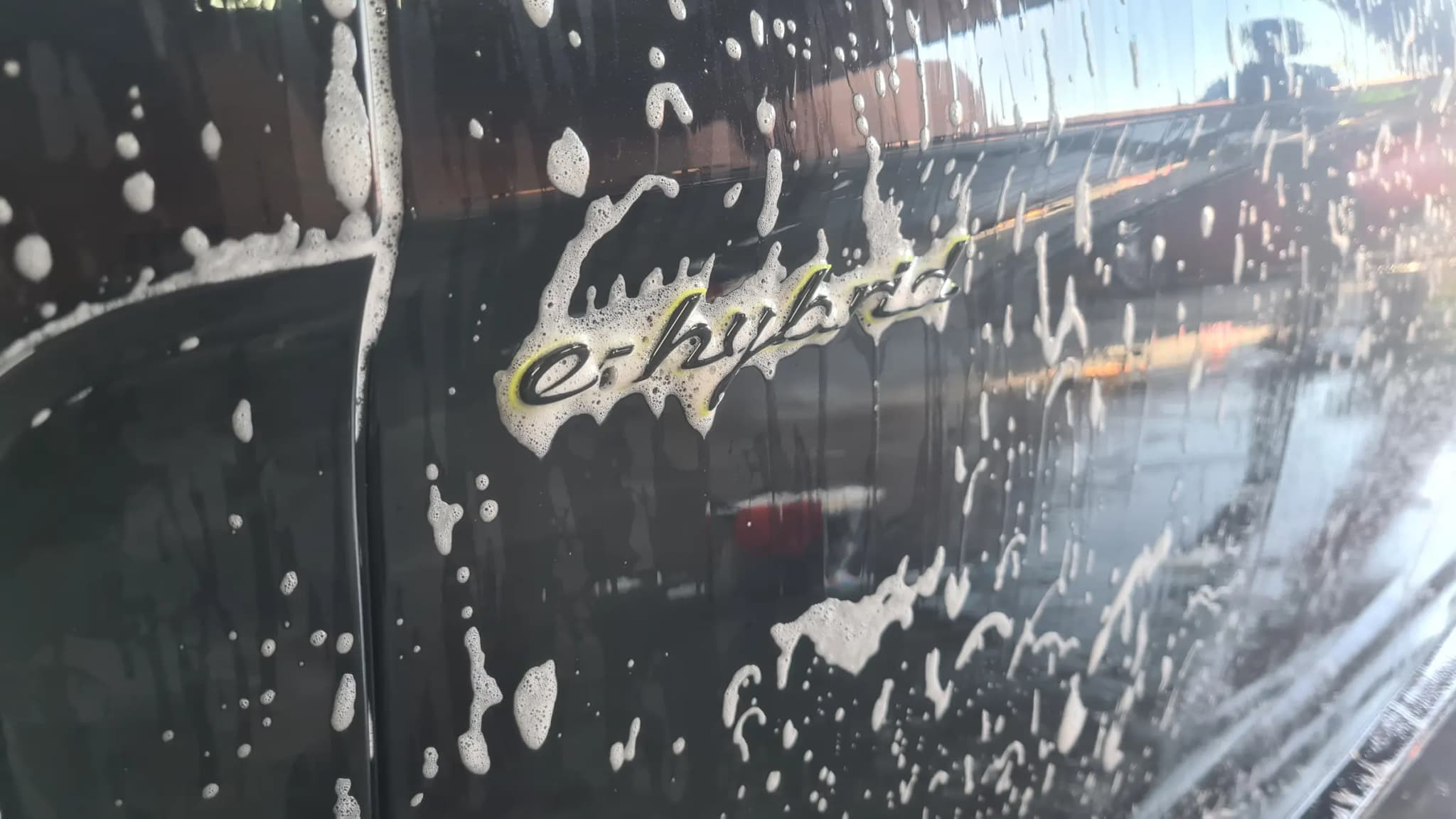
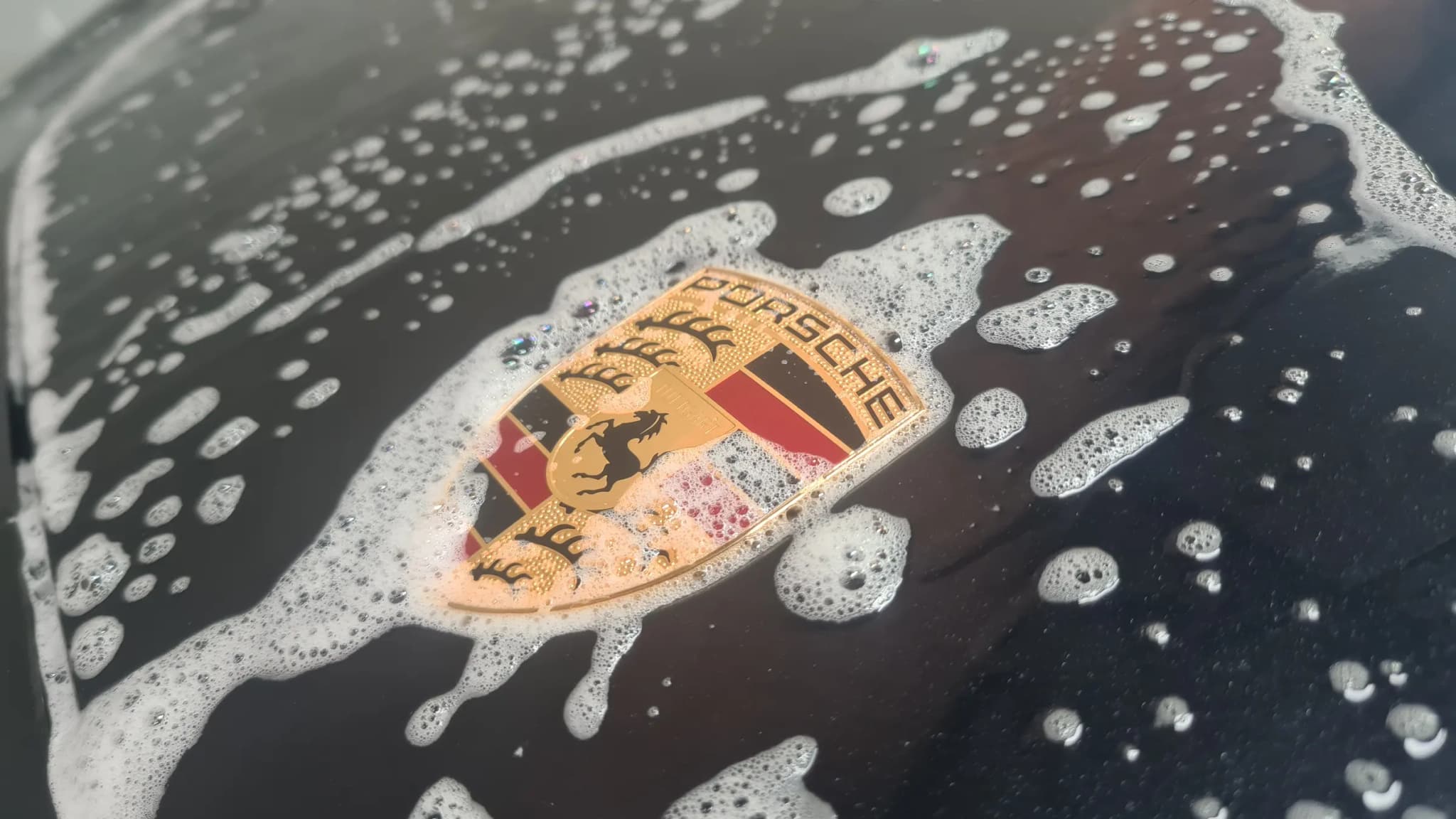
Snow foam pulling into beads and running off the coated rear quarter of a Porsche around the e-hybrid badge
Contact angle, coated rear quarterPD
Scratch resistance

An honest account of hardness

A cured coating is harder than clear coat and it genuinely resists the light marring that washing inflicts — the fine swirls that dull a finish over a few years. It will not stop a key, a trolley, a stone chip or a careless automated wash brush. Anyone who tells you their coating makes paint scratch-proof is selling you something we do not sell.

  • Resists wash-induced micro-marring, the main cause of dulling
  • Adds a measurable sacrificial layer above your clear coat
  • Does not prevent impact damage, stone chips or deliberate scratches
  • Pairs well with paint protection film on high-impact panels
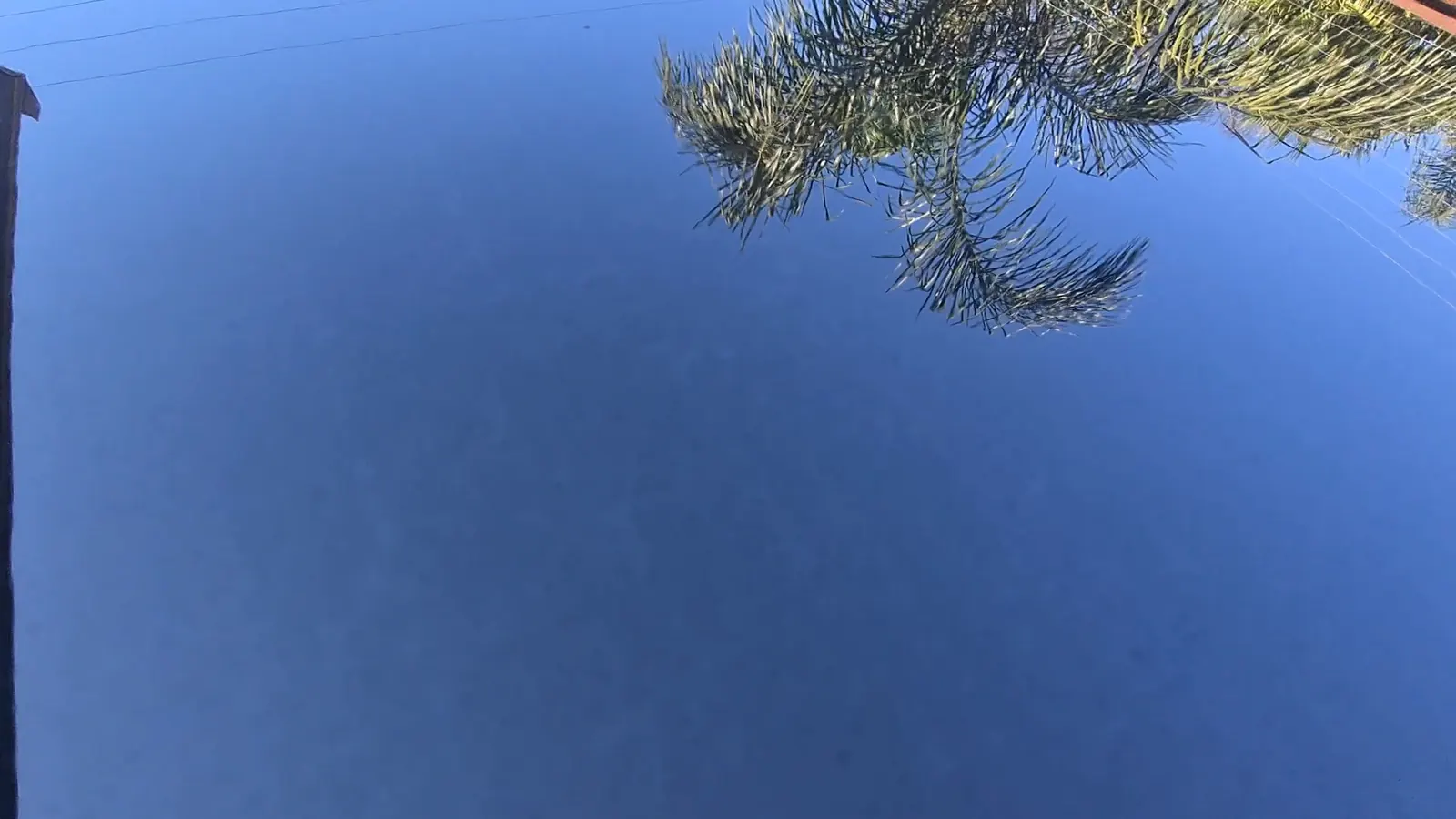
A coated dark panel returning a tree and open sky as one undistorted image
Coated clear coat, sky returned wholePD
Long-term value

It is cheaper than the alternative

A coating is a single outlay measured against several years of quarterly waxing, faster paint deterioration and a duller car at trade-in time. Coated cars wash faster, need no sealant top-ups, and present better when they are sold. On a vehicle you intend to keep past three years, the coating usually costs less than the wax and correction it replaces.

  • Replaces years of sealant and wax applications
  • Washing takes noticeably less time and less contact
  • Paint condition at resale is visibly better than an uncoated equivalent
  • Correction done once, at the start, rather than repeatedly
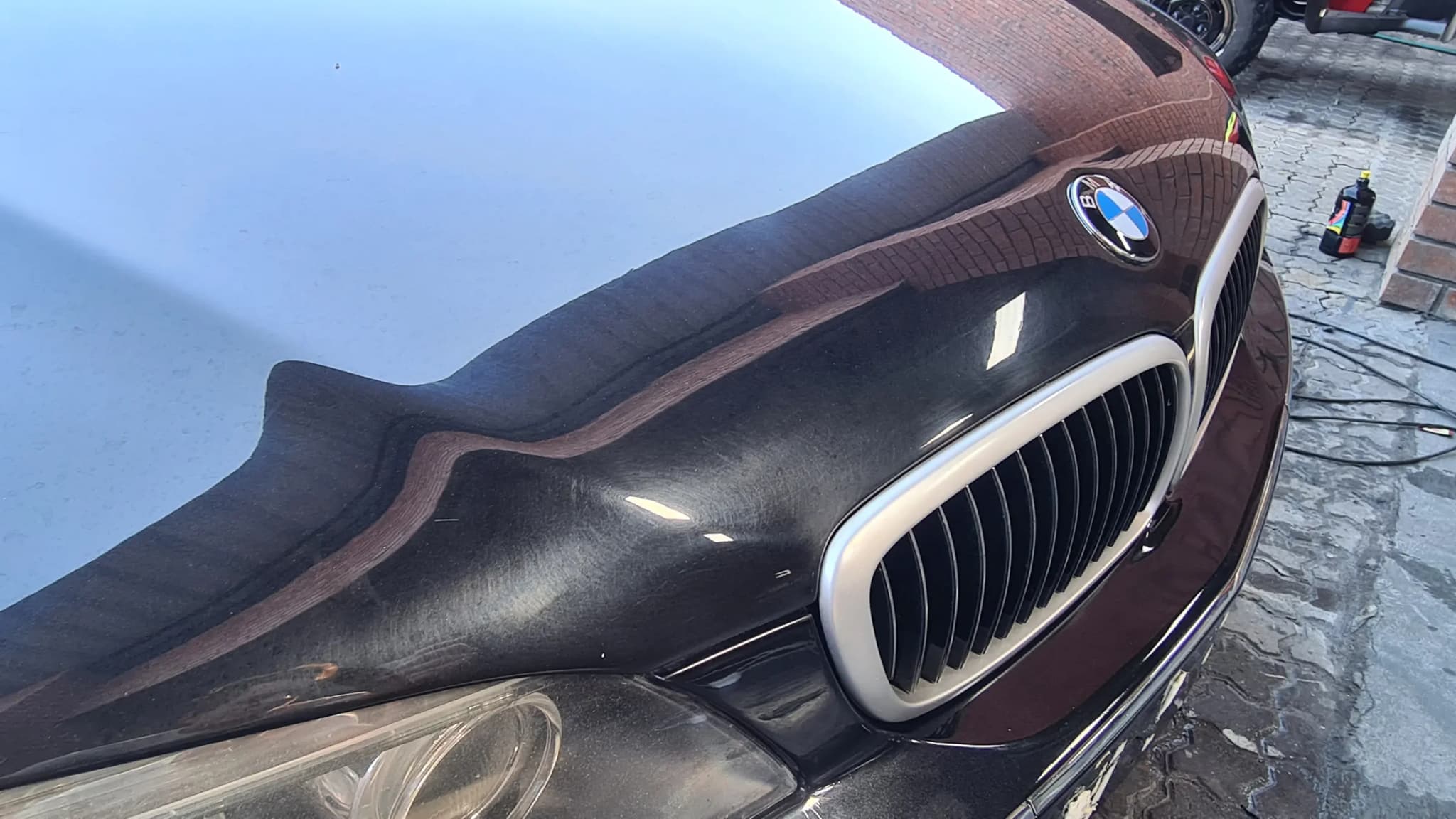
Raking sunlight across an uncoated black bonnet showing the haze left by years of automated washing
Unprotected, after years of automatic washingPD
Gloss & depth

The coating does not add shine. It stops taking it away.

A cured ceramic layer has a higher refractive index than bare clear coat and it is optically flatter, so light entering it is returned as one clean image rather than scattered by the micro-texture underneath. That is what people read as depth — the sense that you are looking into dark paint rather than at it. The catch is that a coating is transparent and perfectly faithful: it magnifies whatever surface it is laid over. On corrected paint that is the whole point. On swirled paint it preserves the swirls in high resolution for five years, which is exactly why we will not coat a car we have not corrected first.

  • Higher refractive index than bare clear coat — light returns as one image
  • Optically flat film fills nothing, but scatters nothing either
  • Typical measured gain of 15 to 25 gloss units over corrected paint
  • Faithful to what is underneath — which is why correction comes first
A coated black Porsche photographed from above the rear quarter, the reflection staying straight through the curve
Reflection held through the curvePD
Beyond the paint

Glass, wheels, trim and plastics each get their own chemistry

Coating only the painted panels solves a quarter of the problem. Glass is the surface you look through in the rain; wheels take more chemical and thermal punishment than anything else on the car; exterior trim is the first thing to chalk and go grey; and plastic headlight lenses yellow under ultraviolet until the beam pattern collapses. Each of those substrates needs a different formulation with a different bond mechanism and a different service life, so they are quoted and applied as separate treatments — not as one bottle wiped over everything.

  • Glass coating — rain clears at speed, wipers go quiet, no more etched water spots
  • Wheel and caliper coating — heat-stable, so brake dust releases under a rinse rather than baking on
  • Exterior trim and rubber — a coating that stops the chalking and greying, not a dressing that washes off
  • Headlight lenses — restored, then sealed with a fresh ultraviolet layer to hold clarity
  • Wrap and PPF-safe systems where the car is already filmed
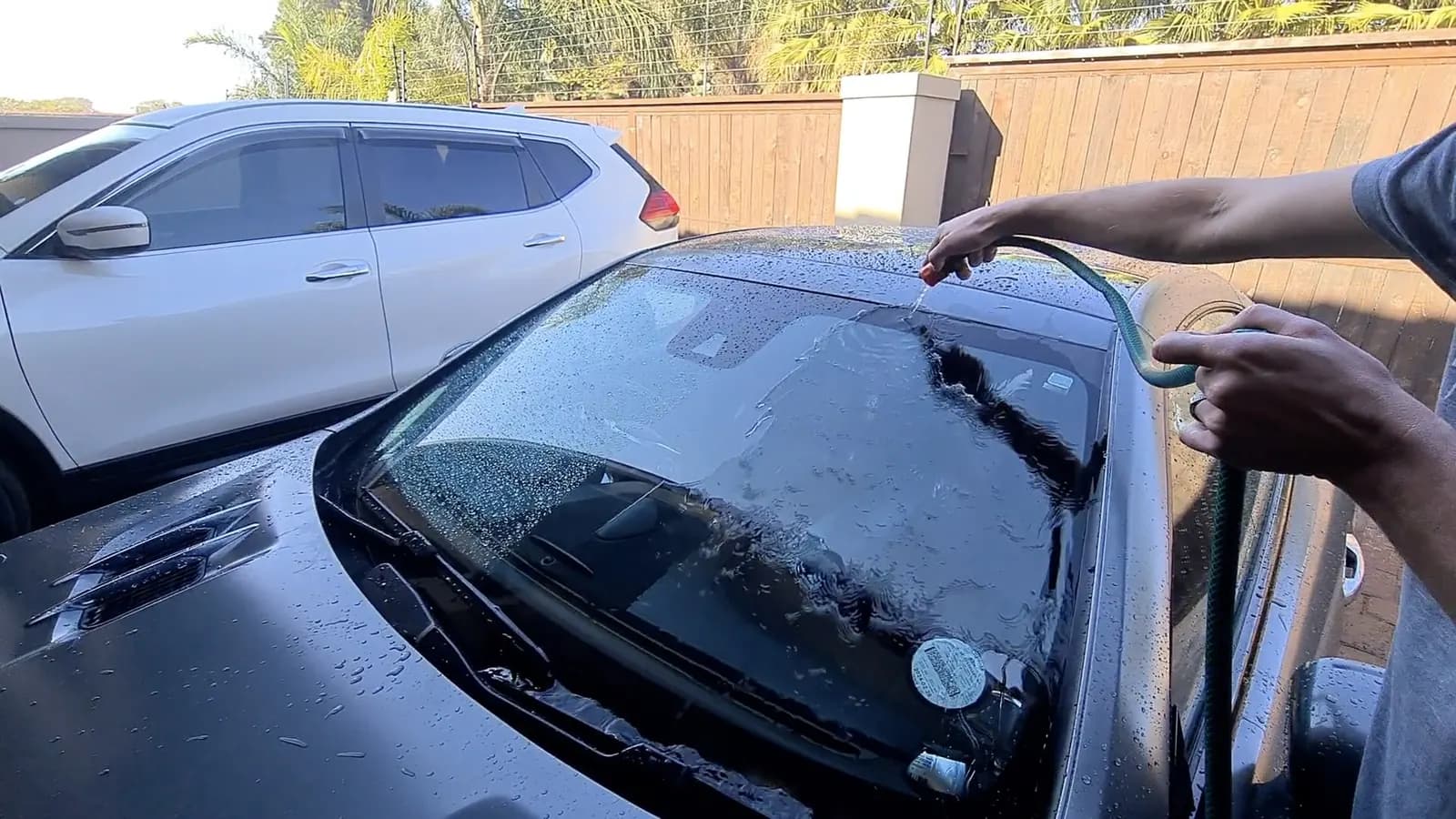
A ceramic glass coating being worked across a windscreen with a block applicator
Glass coated on its own chemistryPD
Living with it

Washing a coated car is a genuinely different job

This is the benefit owners actually notice, and it is the one nobody puts in the brochure. Because contamination cannot key into a slick, low-energy surface, it sits on top waiting to be rinsed away instead of bonding to the clear coat. The pre-soak does most of the work. The contact wash becomes shorter and gentler, which matters enormously, because contact is what put the swirl marks there in the first place. Brake dust releases from coated wheels. Bugs come off the front bar without a soak. What used to be a careful two hours becomes a comfortable forty minutes.

  • Most soiling leaves during the pre-soak, before anything touches the paint
  • Shorter, lighter contact washing — the single biggest cause of new defects
  • Brake dust releases from coated wheel faces under a rinse
  • No more drying marks: water sheets off rather than sitting in droplets to evaporate
  • A ceramic booster at each maintenance visit restores the contact angle
Snow foam breaking and running off a coated bonnet, taking the soiling with it
Most of it leaves in the pre-soakPD
Benefits

What you get out of it.

Broad pH

Chemical resistance

Acidic fallout, alkaline detergents, bug residue and sap land on the coating instead of your clear coat.

Anti-oxidation

UV stability

Absorbs the ultraviolet load that would otherwise deplete your paint's own protection and start oxidation.

112°

Hydrophobic surface

Water beads and self-releases, taking road film with it and leaving far less spotting behind.

9H film

Marring resistance

A harder sacrificial layer takes the light contact damage that ordinarily dulls paint over a few seasons.

Half the time

Effortless washing

Contamination has less to bond to, so a maintenance wash is quicker and needs far less mechanical contact.

94 GU

Held gloss

Corrected paint under a stable film keeps its reflection sharp instead of softening year on year.

Packages

How it is packaged.

Every package starts with the same inspection. What differs is how far the correction goes and how long the protection is warranted for.

Coating · Two year

Single-layer system on corrected paint. The sensible entry point for a daily driver.

Quoted after inspection

1–2 days

  • Decontamination wash, iron and tar removal
  • Clay treatment
  • Single-stage machine polish
  • One coating layer on paint
  • Glass and wheel faces coated
  • Written two-year warranty
Most requested

Coating · Five year

Multi-layer system over two-stage correction. Our most requested package.

Quoted after inspection

2–3 days

  • Full decontamination and clay treatment
  • Two-stage correction — cut and refine
  • Base coat plus top coat on paint
  • Glass, wheels, calipers and exterior trim coated
  • Interior leather and fabric protection
  • Written five-year warranty and annual inspection

Coating · Concours

For collections, show cars and anything with paint that cannot be replaced.

Quoted after inspection

4–6 days

  • Paint depth mapped panel by panel before any correction
  • Three-stage correction to a defined finish
  • Multi-layer coating with sacrificial top layer
  • Every exterior surface coated including underbonnet
  • Full photographic and measurement record
  • Annual maintenance detail included
On the day

Exactly how this job runs.

Tap any stage to see what happens inside it.

    • Clear coat thickness recorded per panel
    • Previous repairs and thin areas flagged
    • Achievable finish agreed in writing before work starts
Expected lifespan

How long it holds

Two-year system
24–30 months

Single layer, daily driver, washed correctly

Five-year system
5–7 years

Multi-layer over full correction, garaged where possible

Full hardness
7 days

Touch-dry in hours; avoid washing for the first week

Annual inspection
Every 12 months

Required to keep the warranty live; usually free

Keeping a coating alive

Coatings fail from bad washing far more often than from age. The film is chemically tough but it can be abraded, and automated brush washes will take years off it in a single pass.

  • 01Two-bucket contact wash with a pH-neutral shampoo, or a touchless rinse
  • 02Never use an automated brush wash — it is the single fastest way to ruin the finish
  • 03Dry with a clean plush towel or filtered blower, never a chamois dragged across dry paint
  • 04Remove bird droppings and bug residue within a day; the coating buys time, not immunity
  • 05Book the annual inspection — a topper reset costs a fraction of a re-coat
Questions

Ceramic, answered.

All questions
  • A liquid silica polymer that cross-links into a hard, transparent film chemically bonded to your clear coat. Unlike wax, which sits on top and washes away over weeks, the coating becomes a semi-permanent sacrificial surface that takes chemical and ultraviolet attack instead of your paint.

Next step

Ready to talk about ceramic?

Send us the details and you will have a written, itemised quote within one working day.