Skip to content

Premium vehicle detailing, paint correction and ceramic coating

Marine Division · Gelcoat, metal and running gear

Saltwater is patient. It takes the hull a season at a time.

A boat lives in the most aggressive environment we work in. Salt, constant ultraviolet, waterline growth and the mechanical punishment of moving through water all attack gelcoat and metalwork at once. Our marine division corrects those surfaces back and then puts a ceramic layer between them and the sea.

Coated hull sitting clean at the waterline with water sheeting off the topsidesPD
3yrs
Coating service life

On gelcoat, with the recommended wash cycle

5%
Performance improvement

Published figure, up to — see the qualifier below

2days
Typical vessel

Correction and coating on a mid-size hull

The difference

A slick hull moves through water differently.

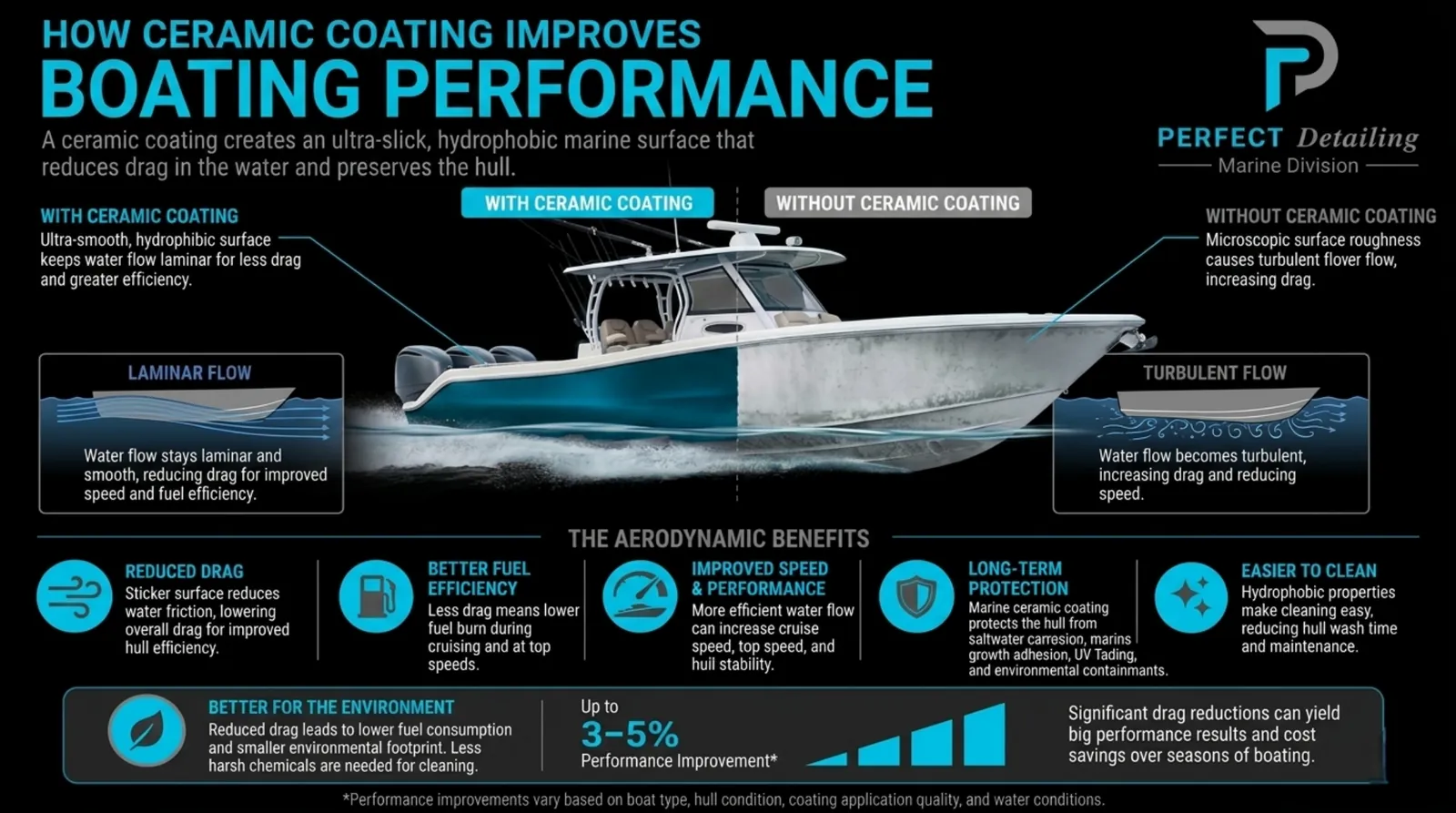
Water behaves like any other fluid across a surface. A rough, fouled hull drags a turbulent boundary layer behind it; a smooth, hydrophobic one keeps that flow attached for longer. It is the same physics we work with on paint and on wings, in a far less forgiving medium.

Split comparison of a hull with and without ceramic coating, showing laminar flow against turbulent flow and the resulting drag difference
Without ceramic coating

Microscopic surface roughness and early fouling break up the flow along the hull. The boundary layer becomes turbulent, drag rises, and the vessel works harder for the same speed.

With ceramic coating

An ultra-smooth, hydrophobic surface keeps water flow attached for longer, reducing skin friction. The hull stays cleaner between lifts, which compounds the effect across a season.

Up to 3–5%Performance improvement

Perfect Detailing's published figure. Performance improvements vary based on boat type, hull condition, coating application quality and water conditions — a heavily fouled hull recovers far more than a well-maintained one, and no figure should be treated as a guarantee for a specific vessel.

Reduced drag

A slicker surface lowers water friction and overall hull drag.

Better fuel efficiency

Less drag means lower burn at cruise and at top speed.

Improved speed

More efficient water flow supports cruise speed and hull stability.

Long-term protection

Guards the hull against saltwater corrosion, growth adhesion and UV fading.

Easier to clean

Hydrophobic behaviour cuts hull wash time and maintenance effort.

Deep clean & growth removal

Everything below the waterline has to come off first

Marine growth, waterline scum and the tide-line stain that comes with a season in the water are removed before any correction begins. Growth is not simply scrubbed away — it is released and lifted so that the gelcoat underneath is not scoured in the process, because gelcoat that has been sanded by a careless wash is exactly what we then have to correct.

  • Hull growth and waterline staining released chemically, then rinsed
  • Topsides, non-skid and deck hardware cleaned separately
  • No aggressive scouring on gelcoat — it causes the dullness we are here to fix
  • Bilges, lockers and hatch gutters cleaned while access is open
Everything below the waterline has to come off first
Gelcoat correction

Chalked gelcoat comes back further than most owners expect

Oxidised gelcoat is not paint and does not behave like it. It is a thick, pigmented layer that chalks from the surface down under sustained ultraviolet load, which means there is usually a great deal of sound material underneath. Multi-stage machine correction removes the dead layer and restores depth and colour, and on a hull that has been neglected for a few seasons the difference is the single most dramatic result we produce.

  • Multi-stage cut and refine, worked to a defined finish
  • Colour and clarity restored rather than masked with a filler polish
  • Non-skid and textured areas worked by hand where a machine would burn
  • Thin or previously repaired areas identified and flagged before work starts
Chalked gelcoat comes back further than most owners expect
Marine ceramic coating

A barrier built for salt and sun

Once the surface is corrected we apply a marine-grade ceramic system rated for continuous saltwater exposure. It bonds to the gelcoat and gives a hard, ultraviolet-stable, strongly hydrophobic surface: salt rinses off instead of drying into the pores, staining is dramatically reduced, and the wash-down at the end of a day on the water becomes a fraction of the job it was.

  • Rated for continuous saltwater immersion and spray
  • Ultraviolet-stable — the mechanism that chalks gelcoat in the first place
  • Salt and organic staining release with a freshwater rinse
  • Applied to topsides, hull and superstructure as scoped
A barrier built for salt and sun
Metalwork & running gear

Propellers, railings and hardware

Stainless railings, pulpits, cleats and fittings are polished and coated so they stop tea-staining between washes. Propellers and running gear get their own treatment: a smooth, coated prop fouls more slowly and stays cleaner between lifts, and reduced barnacle adhesion on the blades is worth more to a vessel's efficiency than almost anything else we do underwater.

  • Stainless polished and coated to slow tea-staining
  • Propellers and shafts treated to reduce barnacle adhesion
  • Anodised and painted metalwork handled with the appropriate chemistry
  • Anodes, transducers and sacrificial fittings deliberately left alone
Propellers, railings and hardware
Benefits

What you get out of it.

Hydrophobic

Salt stops soaking in

A sealed, non-porous surface means salt rinses away instead of drying into the gelcoat and etching it.

UV-stable

Ultraviolet stability

The coating absorbs the exposure that chalks gelcoat and fades pigment across a season on the water.

Rinse-and-go

Faster wash-downs

Contamination releases with a freshwater rinse, turning a long end-of-day job into a short one.

Less adhesion

Slower fouling

A slicker hull and coated running gear give marine growth far less to key into between lifts.

Multi-stage

Restored colour

Multi-stage correction brings chalked gelcoat back to depth and clarity rather than dressing over it.

At resale

Value held

A vessel that has been protected rather than rescued presents very differently at survey and at sale.

Packages

How it is packaged.

Every package starts with the same inspection. What differs is how far the correction goes and how long the protection is warranted for.

Seasonal wash & protect

Maintenance treatment for a vessel already in good condition.

Quoted by vessel length

Half a day to a day

  • Full exterior wash and salt removal
  • Waterline treatment
  • Topside sealant refresh
  • Stainless polish
  • Interior wipe-down and glass
Most requested

Gelcoat restoration & coating

Full correction and marine ceramic coating. The division's core service.

Quoted after vessel survey

2–4 days

  • Deep clean and marine growth removal
  • Multi-stage gelcoat correction
  • Marine ceramic coating on hull and topsides
  • Stainless and metalwork polished and coated
  • Running gear treated for reduced fouling
  • Written aftercare programme

Commercial vessel programme

Scheduled protection for charter, ferry and working craft.

Quoted per vessel, per cycle

Scheduled around your operating window

  • Survey and cycle planned around your operations
  • Coating applied at a scheduled lift
  • Reduced-cost maintenance washes between lifts
  • Condition reporting for the vessel file
  • Consolidated invoicing across a fleet
On the day

Exactly how this job runs.

Tap any stage to see what happens inside it.

    • Gelcoat condition and oxidation assessed
    • Previous repairs and thin areas flagged
    • Anodes and sacrificial fittings excluded by default
Expected lifespan

How long it holds

Coating on gelcoat
2–3 years

Depending on time in the water and whether the vessel is covered

Coating on metalwork
12–18 months

Stainless and hardware, refreshed at the annual service

Full hardness
24–48 hours

The vessel should stay out of the water through the cure

Annual inspection
Every 12 months

Ideally aligned to a scheduled lift

Living with a coated hull

The coating makes maintenance quicker; it does not remove it. Salt left to dry on any surface, coated or not, is still salt left to dry.

  • 01Rinse with fresh water after every outing — this is the single most valuable habit
  • 02Use a pH-neutral boat soap; avoid acidic hull cleaners on coated gelcoat
  • 03Never use abrasive pads or scouring powder on a coated surface
  • 04Book the annual inspection at a lift, when the hull is accessible anyway
  • 05Tell us if the vessel changes mooring or usage — the cycle should change with it
Questions

Marine, answered.

All questions
  • No, and it does not replace it. Antifouling is a biocidal paint system applied below the waterline to stop marine growth taking hold, and that remains your yard's job. Our marine ceramic coating protects gelcoat, topsides, superstructure and metalwork against salt, ultraviolet and staining, and makes the surfaces above and around the waterline dramatically easier to keep clean. On running gear it reduces how readily barnacles adhere, which is a different mechanism to antifouling and complements it.

Next step

Ready to talk about marine?

Send us the details and you will have a written, itemised quote within one working day.